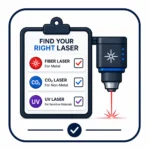
Select the Right Laser
Answer 2 questions and get a personalized recommendation from Haotian's full lineup of fiber, CO2, UV, CNC, and laser cleaning machines. Honest about what each machine does well and what it does not.
Recommendations based on 15 years of laser manufacturing. Every machine ships with free DDP shipping (US, Canada, EU), free CIF shipping worldwide, and $500 in gifts.
Question 1 of 2
What do you want to make or do?
Why we ask: The right laser depends on what you actually plan to make. Pick the scenario closest to your work and we will route you to the right machine.
🔧General Metal Work
💍Jewelry & Personal Items
🎯Firearms
🥤Drinkware & Promotional
🪵Wood, Leather & Acrylic
🥃Glass, Crystal & Stone
🔬Technical & Industrial
How much will you use it?
Why we ask: Volume drives the power tier. Too small and you waste hours per job. Too big and you waste money on capacity you will not use.
Common Questions Beginners Ask
Do I need fiber or CO2 for tumbler engraving?
CO2 galvo is the right tool for coated tumblers. The CO2 wavelength vaporizes the powder coating cleanly without touching the bare metal underneath, giving a professional result. Fiber lasers can also remove the coating, but they leave discoloration where the bare metal catches the beam. CO2 is the better tool, not the only one. We recommend the 35W CO2 galvo or 40W CO2 galvo for hobby and side-business volumes, and the 60W water-cooled CO2 galvo for production drinkware.
Can a fiber laser do color marking on stainless steel?
Only MOPA fiber lasers can produce true color marking. MOPA stands for Master Oscillator Power Amplifier, and the technology lets you adjust the pulse width from 2 to 500 nanoseconds. By controlling the pulse, the laser controls the oxide layer thickness on stainless steel and titanium, which is what creates the color. Standard fiber lasers (Raycus, LP series, Q-switched sources) have fixed pulse widths and cannot produce colors. All Haotian fiber lasers in the EM7, M7, and M8 families are MOPA capable. The 30W JPT EM7 MOPA fiber laser is the affordable entry point for color marking work.
What is the difference between fiber, CO2, and UV lasers?
Each laser uses a different wavelength that interacts with materials differently. Fiber lasers operate at 1064 nanometers and work best on metals through thermal energy. CO2 lasers operate at 10,600 nanometers and work best on organic materials like wood, leather, paper, and acrylic, with a larger spot size that makes them up to 5 times faster than fiber on the same job. UV lasers operate at 355 nanometers and use a photochemical reaction (cold marking) instead of heat, making them ideal for sensitive materials like glass, plastics, silicone, PCBs, and medical devices. UV is the most versatile marking laser but cannot deep engrave metal. Many serious shops run two or three different lasers for different work.
How do I drill holes through glass with a laser?
Glass drilling requires the JPT M8 series specifically. Standard fiber lasers cannot drill glass because the 1064nm wavelength passes through transparent material. The M8 has peak power above 100 kilowatts and ultra-short pulses (down to 4 nanoseconds) that create a non-linear absorption effect, allowing real holes through borosilicate, soda lime, and quartz glass. The 50W JPT M8 MOPA fiber laser is the most affordable entry to glass drilling at $5,300, while the 200W JPT M8 fiber laser is the flagship for industrial glass production.
Can a galvo laser cut metal sheets?
Galvo fiber lasers can cut small metal parts within the lens field size (110mm to 300mm), up to about 1.5 to 2mm thick depending on power. They are ideal for jewelry, pendants, watch parts, dog tags, and small precision components. For full sheet cutting you need a CNC fiber laser cutter, which is a different machine class with a 1m x 2m or 1.5m x 3m bed and power from 1500W to 6000W or higher. CNC fiber cutters can also cut small parts precisely if you have the workshop space and budget.
What is laser stippling on Glock frames and what laser do I need?
Laser stippling is the process of using a laser to texture the polymer frame of a pistol for grip improvement and customization. The right tool is a fiber MOPA laser, not a CO2 laser. CO2 would melt and bubble the polymer because it relies on thermal energy. Fiber MOPA uses adjustable pulse width to ablate the polymer surface cleanly without melting. Working settings range from 30 to 50 percent power, 20 to 300 kilohertz frequency, and 400 to 1500 millimeters per second speed. Standard Raycus or LP fiber lasers cannot do stippling because they have fixed pulse widths. The 30W JPT EM7 MOPA fiber laser is the affordable entry, the 60W EM7 is the production sweet spot, and the 100W M7 is for shops doing stippling plus slide engraving plus deep engraving on the same machine.
What is the difference between MOPA and standard fiber lasers?
Standard fiber lasers (often called Q-switched, Raycus, or JPT LP series) have a fixed pulse width, usually around 100 nanoseconds. They deliver a heavy hit of energy that excels at deep metal engraving and fast marking, but they cannot do color marking and they often melt sensitive plastics. MOPA fiber lasers have adjustable pulse width from 2 to 500 nanoseconds, giving fine control over how much heat stays in the material. This flexibility enables color marking on stainless and titanium, black-on-anodized aluminum marking, cold marking on sensitive plastics, and clean work on thin metals. MOPA costs more upfront but delivers more capability for the same wattage. All Haotian EM7, M7, and M8 fiber lasers are MOPA capable.
How long does a fiber laser last?
A properly maintained fiber laser runs over 100,000 hours of rated source operation, which translates to more than 10 years for most workshops. Fiber lasers are extremely efficient at converting electricity into laser output, with about 30 percent wall-plug efficiency compared to CO2 lasers at 10 to 15 percent. Source lifespan is one of the main reasons fiber lasers are preferred for industrial applications despite higher upfront cost. Haotian backs all fiber laser sources and machines with a 3-year warranty plus lifetime email support.
Can UV lasers mark metal?
Yes, UV lasers can mark all common metals including stainless steel, aluminum, brass, copper, silver, gold, and titanium with high contrast and fine detail. UV is actually superior to fiber on highly reflective metals like gold, silver, and copper because the 355nm wavelength is absorbed where 1064nm fiber gets reflected and creates a splash effect. The one limitation is depth: UV machines are typically 5 to 15 watts and cannot achieve the meaningful depth that fiber lasers produce on metal. For surface marking with detail, UV is excellent on metals. For deep engraving, fiber wins. The 5W UV laser starts at $5,400, with 10W and 15W variants for production volume.
Can a fiber laser cut acrylic?
No. Fiber lasers cannot cut clear acrylic because the 1064nm wavelength passes straight through transparent material. Even on colored acrylic, fiber produces inconsistent results. CO2 is the right tool for acrylic. A 40W to 60W CO2 laser cuts up to 10mm acrylic, while 80W to 100W cuts 15 to 20mm. The 4060 100W CO2 gantry cuts acrylic at production speed for sign shops, and the 1390 CO2 gantry handles 12mm acrylic at production volume.
What is the best laser for engraving wood?
CO2 lasers are the standard tool for wood engraving and cutting. The 10,600nm wavelength is absorbed beautifully by wood. For small wood items at hobby scale, the 35W or 40W CO2 galvo is the right choice. For wood panel cutting (signs, furniture parts, models), a CO2 gantry is needed. The 4060 CO2 gantry handles small panels, the 6090 100W CO2 gantry covers most commercial sign work, and the 1390 RECI gantry cuts up to 12mm wood at production speed. Fiber lasers should never be used for wood, the wavelength scorches it inconsistently.
What is the best laser for jewelry engraving?
Fiber lasers are the standard for jewelry. They mark all metals (gold, silver, platinum, brass, stainless, titanium) with high precision and clean edges. For inside-ring engraving, a rotary attachment is required, and Haotian includes a free D60 mini rotary with every fiber laser. The 30W JPT EM7 MOPA fiber laser is the most affordable entry for jewelry shops, with the 60W EM7 as the production sweet spot. UV lasers complement fiber for shops that work with reflective precious metals at high volume, since UV does not produce the splash effect that fiber sometimes creates on gold and silver.
What is the best laser for engraving knives and blades?
Knife and blade work needs deep engraving on hardened steel, so power matters. The 60W JPT EM7 MOPA fiber laser is the entry point for production knife work, the 100W JPT M7 fiber laser is the sweet spot for most knife shops, and the 200W M7 fiber laser handles industrial volumes. MOPA pulse control gives the cleanest deep engraving without burning the surrounding metal.
How do I engrave granite, marble, or slate?
Stone engraving has two paths. CO2 gantry is the versatile choice that works across all stone types (slate, marble, granite, sandstone, basalt) producing frosted-white marks via thermal vaporization. The 6090 100W CO2 gantry and 1390 CO2 gantry are the right scale for most stone shops. Fiber laser excels on dark polished stones (black granite, basalt) producing deeper, sharper marks (up to 0.5mm in single pass) but struggles on light or textured stones. For memorial shops working primarily on dark stone, the 60W EM7 or 100W M7 fiber laser gives crisper detail.
What is the best laser for rubber stamps?
UV is best for rubber stamps because the cold-marking process ablates rubber cleanly without melting, retaining the finest detail in small text and intricate logos. The UV spot size is about 30 times smaller than CO2, holding detail that CO2 cannot match. The 5W UV laser is the entry point for stamp shops, with the 10W UV laser for higher volume. CO2 galvo is a faster and cheaper alternative for production volume, but loses fine detail. Fiber laser is wrong for rubber stamps.
What is pulsed laser cleaning and what materials can it work on?
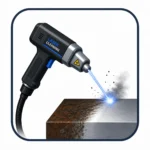
Pulsed laser cleaning is a separate machine class from engraving lasers. The principle uses short, high-energy laser pulses to vaporize unwanted material from a surface. The pulse is too short to transfer significant heat into the material underneath, so contaminants vaporize while the substrate stays intact. Pulsed laser cleaning works on metals (rust, paint, oxide, oil), stone (graffiti, soot, pollution residue, biological growth), brick (fire damage, atmospheric staining), wood (paint stripping with careful settings), ceramic, and concrete. The 200W pulse laser cleaning machine is best for delicate work and historic restoration, while the 300W high-power pulse laser cleaning machine is the general workshop tool for rust and paint removal.
How thick of metal can a CNC fiber laser cut?
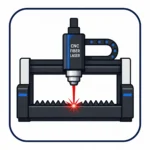
Cutting thickness scales with power. A 1500W CNC fiber laser cuts up to 6mm carbon steel and 4mm stainless. The 3000W CNC fiber laser cuts up to 12mm carbon steel and 8mm stainless. The 6000W CNC fiber laser handles up to 25mm carbon steel and 16mm stainless. Bed sizes range from 1m x 2m (compact shops) to 1.5m x 3m (production fabrication).
Why is a tempered glass safety warning important?
Tempered glass must be engraved BEFORE it is tempered. Engraving already-tempered glass (phone screens, shower doors, car windows, oven doors) creates micro-fractures that can cause the entire panel to shatter explosively. This applies to all laser types. Always verify your glass is annealed (not tempered) before processing. If you need to mark tempered glass, the safest option is laser-applied marking film or chemical etching, not direct laser engraving.
How to Choose Between Fiber, CO2, and UV
The single most important rule in laser selection is matching the wavelength to the material. Lasers work like keys, and materials are locks. Use the wrong key and the work suffers. Use the right key and the result is professional.
Fiber lasers excel at metals because the 1064 nanometer wavelength is absorbed efficiently by metallic structures. They produce deep, durable marks; they handle high-speed production; and MOPA variants are the only laser type that can do color marking on stainless and titanium. Their high precision makes them ideal for QR codes on metal plates, serial numbers, jewelry engraving, firearms work, and industrial part marking. For most shops doing metal work, the 60W JPT EM7 MOPA fiber laser is the sweet spot, while the 100W JPT M7 fiber laser handles production deep engraving and the 200W JPT M7 fiber laser is the industrial workhorse. Browse the full fiber laser lineup. The trade-off is that fiber lasers cannot mark wood, leather, paper, or clear acrylic effectively because the wavelength does not interact with organic materials.
CO2 lasers excel at organic materials because the 10,600 nanometer wavelength is absorbed beautifully by wood, leather, paper, fabric, and acrylic. The bigger spot size compared to fiber means CO2 lasers can finish certain jobs up to 5 times faster, making them the right choice for high-volume production on tumblers, signs, displays, and promotional items. CO2 galvo machines (35W to 60W) are best for small high-speed marking on coated tumblers, drinkware, and small organic items. CO2 gantry machines handle panel cutting and large-format work, the 4060 CO2 gantry for small panels, the 6090 100W CO2 gantry for medium signs, and the 1390 CO2 gantry for full-size production work up to 12mm thick stock. See all CO2 laser options. The trade-off is less micro-precision and an inability to mark bare metal effectively.
UV lasers occupy a different category entirely. Operating at 355 nanometers, UV lasers do not heat the material at all. Instead they use a photochemical reaction that breaks molecular bonds directly. This cold marking process produces zero heat-affected zone, no melting, no charring, and no foaming. UV is the only clean way to mark glass, sensitive plastics, silicone, PCBs, medical devices, and food-grade packaging. UV can also mark all common metals with high contrast and fine detail (and is actually superior to fiber on highly reflective metals like gold, silver, and copper) but it cannot achieve depth. The 5W UV laser is the air-cooled entry point at $5,400, with 10W UV laser and 15W UV laser variants for production volume. Browse all UV laser options.
For most shops, the right answer is to match the dominant material to the laser type, then add complementary machines as the business grows. A jewelry shop typically starts with the 30W or 60W JPT EM7 MOPA fiber laser, then adds a 5W UV laser for glass and crystal awards. A promotional company often starts with a 10W UV laser for material versatility, then adds a 40W CO2 galvo for high-volume drinkware. A fabrication shop starts with a 1500W CNC fiber laser cutter for sheets, then adds a 60W EM7 fiber galvo for marking parts. Single-machine workshops are common at hobby level, but production shops almost always run two or three lasers because no single machine does every material well.
Quick Comparison: Fiber vs CO2 vs UV
| Capability | Fiber Laser | CO2 Laser | UV Laser |
|---|---|---|---|
| Wavelength | 1064 nm | 10,600 nm | 355 nm |
| Best for | Metals | Wood, acrylic, leather | Glass, plastics, electronics |
| Marks bare metal | ✓ Best | ✗ No | ✓ All metals |
| Deep engraves metal | ✓ Best | ✗ No | ✗ Surface only |
| Color marking on stainless | ✓ MOPA only | ✗ No | ✗ No |
| Cuts wood and acrylic | ✗ No | ✓ Best | ~ Thin only |
| Marks clear glass | ✗ Beam passes through | ~ Frosted via fractures | ✓ Cleanest |
| Drills holes through glass | ✓ M8 series only | ✗ No | ✗ No |
| Marks sensitive plastics | ~ Melts most | ~ Can damage | ✓ Cold mark |
| Polymer stippling (Glock) | ✓ MOPA only | ✗ Melts polymer | ✗ Wrong tool |
| Source lifespan (hours) | 100,000+ | 2,000 to 30,000 | 10,000 to 20,000 |
| Wall-plug efficiency | ~30% | 10 to 15% | ~25% |
| Heat-affected zone | Moderate | Significant | Zero (cold mark) |
Featured Haotian Laser Machines by Application
For metal marking work, the most popular machines are the 30W JPT EM7 MOPA fiber laser at $3,700 (the affordable MOPA entry point), the 60W JPT EM7 fiber laser at $4,400 (best seller, the production sweet spot), and the 100W JPT M7 fiber laser at $6,900 on sale (production deep engraving and color marking workhorse). For shops that do not need MOPA features, the 30W Raycus fiber laser at $2,700 and the 50W JPT LP fiber laser at $3,700 are budget-friendly alternatives.
For glass drilling specifically, the JPT M8 series is required. The 50W JPT M8 MOPA fiber laser at $5,300 is the most affordable entry to glass drilling, while the 200W JPT M8 fiber laser at $12,500 is the industrial flagship.
For tumblers, drinkware, wood, leather, and acrylic engraving, CO2 galvo is the standard. The 35W CO2 galvo at $3,500 is the hobby entry, the 40W CO2 galvo at $4,100 is the side-business workhorse, and the 60W water-cooled CO2 galvo at $7,100 is the production tool for full-wrap tumblers.
For panel cutting and signs, the new CO2 gantry lineup covers every scale. The 4060 CO2 gantry with 100W glass tube at $3,500 is the affordable entry, the 6090 100W CO2 gantry at $5,400 is the medium-format workhorse, and the 1390 CO2 gantry with RECI W series tube ($7,000 to $7,450 depending on power) is the flagship for production sign shops cutting up to 12mm acrylic and wood.
For glass, sensitive plastics, PCBs, medical devices, rubber stamps, and electronics, UV is required. The 5W UV laser at $5,400 is the air-cooled entry, the 10W UV laser at $9,100 is the production tool, and the 15W UV laser at $12,000 is the industrial machine for cutting carbon fiber and processing thin foils.
For full sheet metal cutting, the 1500W CNC fiber laser cutter at $19,800 starts the production lineup, scaling to 3000W and 6000W for industrial fabrication. For rust, paint, and coating removal, the 200W pulse laser cleaning machine handles delicate restoration while the 300W high-power pulse laser cleaning machine covers general workshop rust and paint stripping.
Browse Haotian Laser Categories
- Fiber Laser Machines for metal marking, color marking, deep engraving, and small parts cutting. The lineup includes Raycus and JPT LP budget machines, the JPT EM7 MOPA series, the JPT M7 series up to 350W, and the JPT M8 glass drilling series.
- CO2 Laser Machines for tumblers, drinkware, wood, leather, paper, and acrylic. CO2 galvo machines (35W, 40W, 60W) for high-speed branding and CO2 gantry machines (4060, 6090, 1390) for panel cutting are both available.
- UV Laser Machines for glass, sensitive plastics, PCBs, medical devices, and heat-sensitive materials. The lineup covers 5W air-cooled, 10W and 15W water-cooled options, plus the dedicated 5W UV 3D inner crystal marking machine for subsurface engraving.
- CNC Fiber Laser Cutters for production sheet metal cutting from 1500W to 6000W. Bed sizes range from 1m x 2m up to 1.5m x 3m.
- Laser Cleaning Machines for rust removal, paint stripping, surface preparation, and historic restoration. 200W and 300W pulsed fiber options are available.
If you have questions about a specific machine or want a custom configuration, contact the Haotian team at info@haotianlasers.com. Every machine includes free DDP shipping to the United States, Canada, and the European Union; free CIF shipping worldwide; a 3-year warranty on fiber laser sources and full machines (18 months on UV and CO2 machines); lifetime email technical support; and over $500 in free gifts including a rotary attachment, two quartz F-theta lenses, OD6 safety glasses, and a foot pedal.