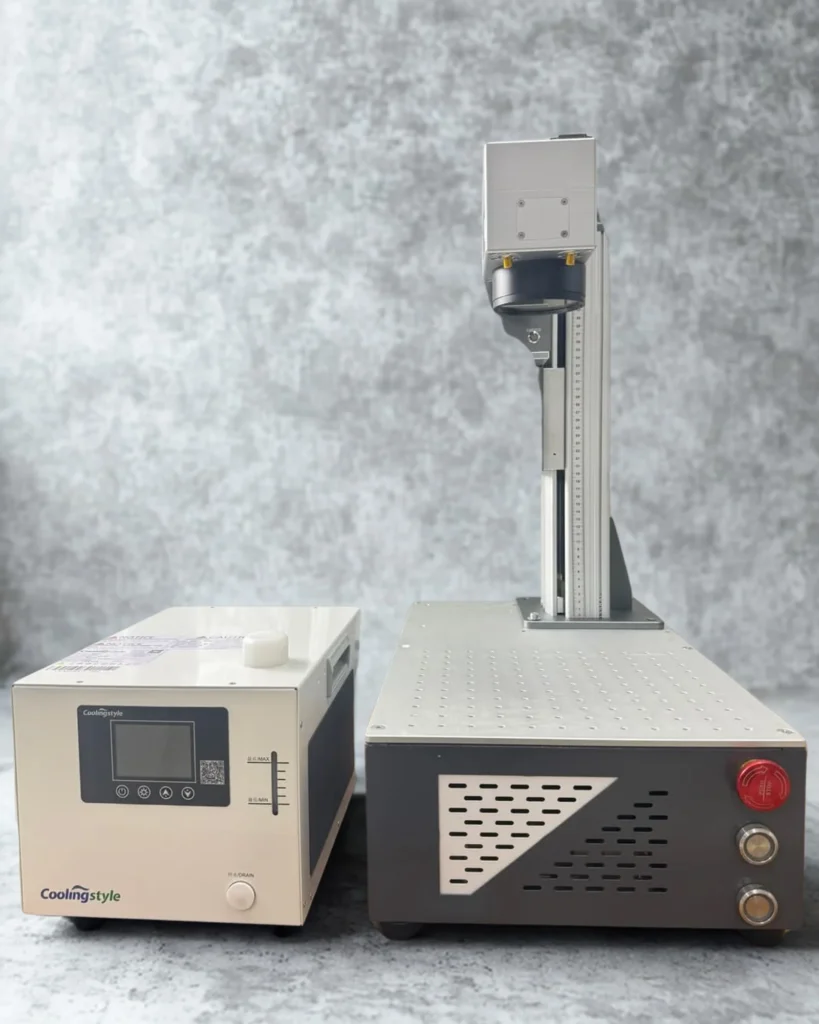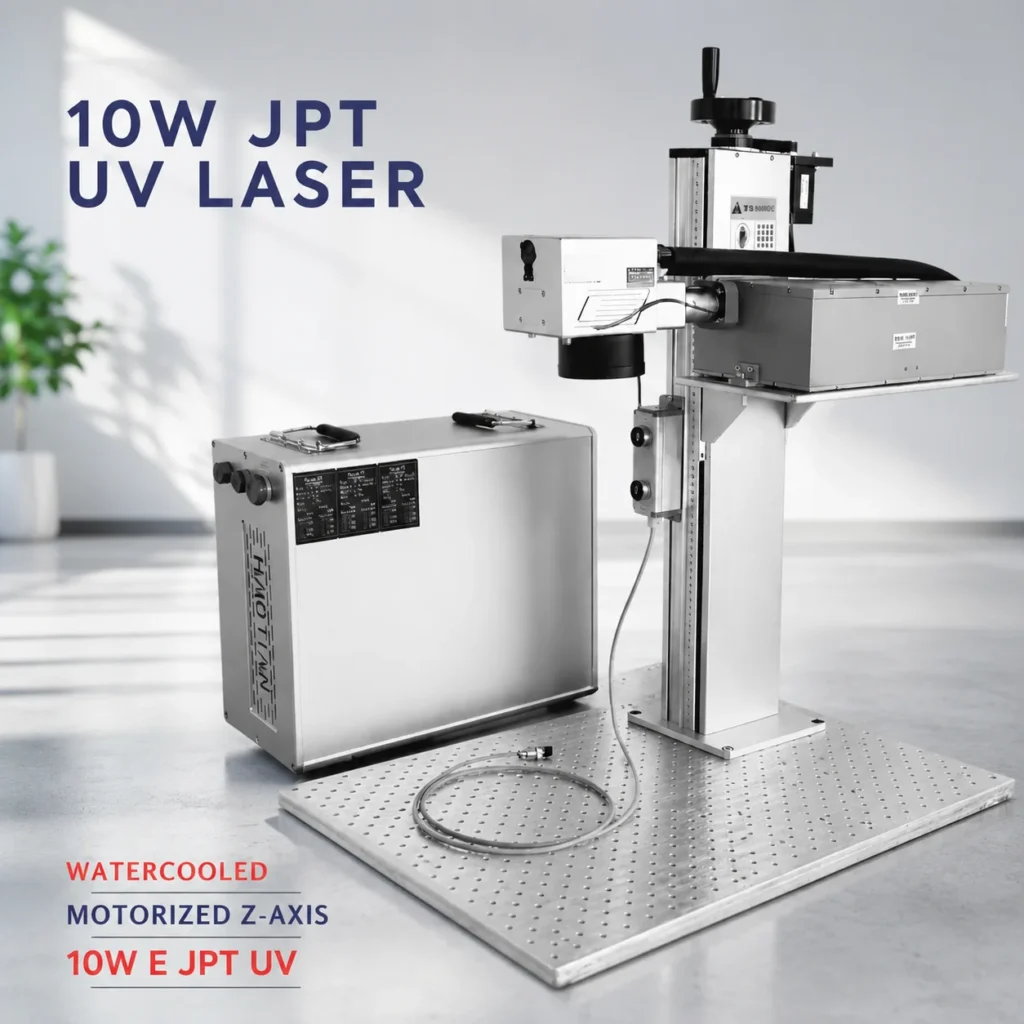


10W JPT S-Series
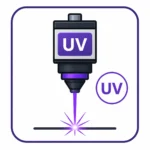
355nm UV Wavelength
Water Cooled
18-Month Warranty
M² ≤ 1.2 Beam Quality
Free DDP
US / CA / EU shipping
JPT S-Series
Top-grade source
18 Months
Full warranty
Cold Mark
Zero heat damage
Free Gifts
Rotary + glasses
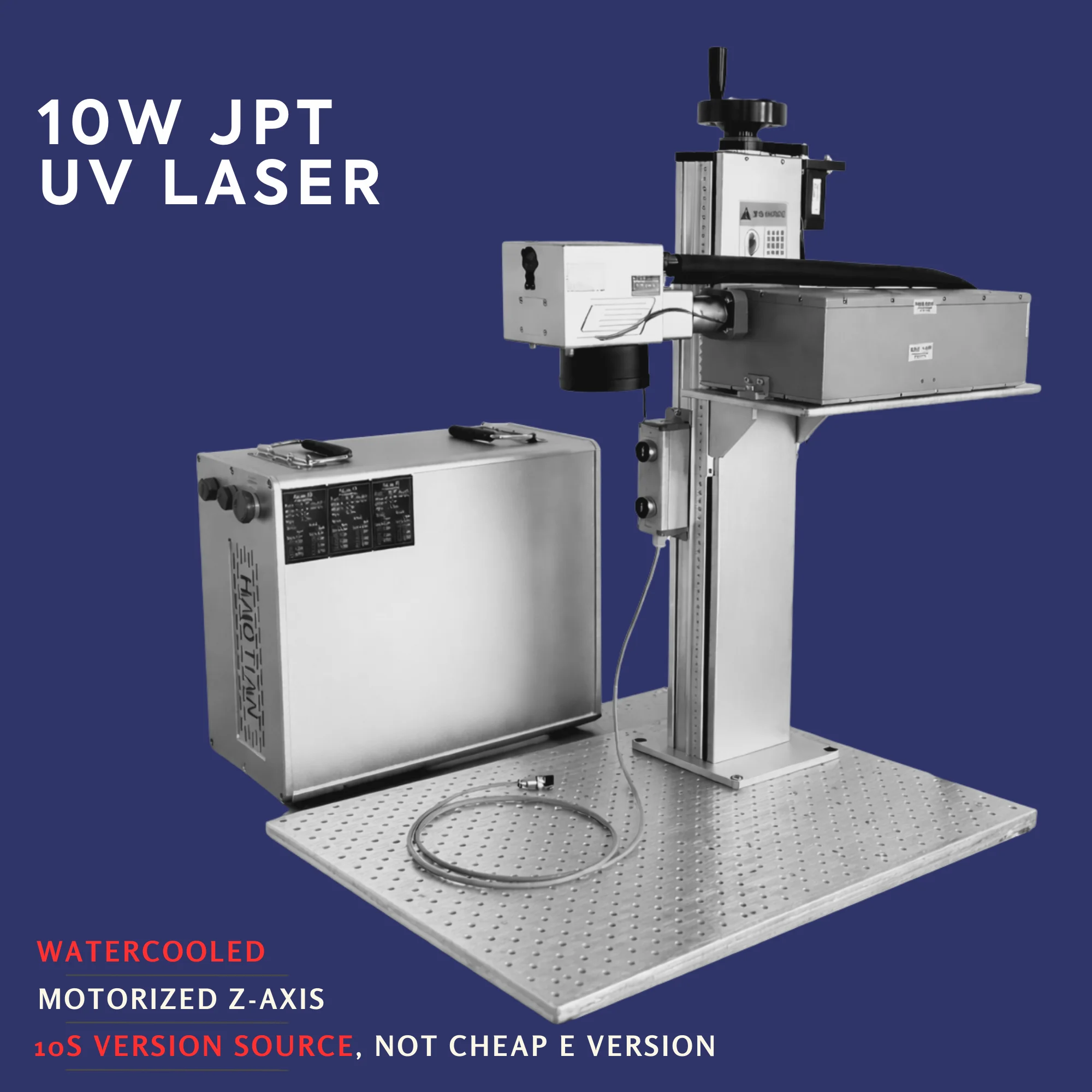
10W UV Laser Marking Machine - JPT Seal-355-10S Water-Cooled Production Workhorse
The professional-grade UV laser for shops that cannot compromise. A 355nm ultraviolet beam interacts with materials through photochemical ablation rather than heat, which is the only way to mark glass cleanly, process PCBs without damaging components, and leave permanent marks on silicone, medical devices, and clear plastics. This is the JPT S-series laser, not the cut-down E economy grade, with water cooling for continuous multi-shift operation and a sealed optical architecture built for real production environments.
Five Reasons This Machine Earns Its Place On The Shop Floor
1
Cold Marking, No Thermal Damage
A 355nm UV photon has roughly three times the energy of a 1064nm fiber photon, so it breaks molecular bonds on contact instead of heating material until it burns. The result is crisp permanent marks on silicone wristbands, medical catheters, PCBs with live components nearby, golf balls, heat-shrink tubing, and pharmaceutical packaging without melting, scorching, or warping anything around the mark zone.
2
JPT S-Series Source, Not E Economy
Haotian only ships S-series JPT UV lasers. The S-grade unit hits M² ≤ 1.2 (compared to ≤ 1.25 on the E economy) with tighter beam circularity and better long-term power stability under heavy production load. The difference shows up in the quality of small-font marks on cases and panels, and in how the laser holds output over a full shift instead of drifting.
3
Water Cooled For Continuous Duty
Water cooling is not a nice-to-have on a 10W UV laser, it is what separates a unit that runs all day from one that thermally throttles after an hour. The Seal-355-10S specifies a 500W cooling capacity requirement, and the machine ships with a matched industrial chiller that keeps the DPSS crystal at operating temperature through shift after shift. Sealed optics also block dust ingress that plagues air-cooled UV lasers.
4
Clean Beam For Micro-Marking
A 0.55mm beam diameter with TEM00 spatial mode and ≤2 mrad divergence delivers the tight focus needed for datamatrix codes, serial numbers, and logos on small electronics, jewelry components, and medical parts. The ≤1.2 M² value means the beam focuses close to the diffraction limit, which is what makes fine text legible down to fonts that fiber lasers smear or blur on heat-sensitive substrates.
5
Sealed Integrated Architecture
JPT built the Seal-355 series as a fully enclosed opto-electrical unit with the drive electronics integrated into the laser housing, which gives it strong EMI resistance on noisy shop floors and eliminates the fragile cable runs that cause service calls on split-box designs. A built-in air self-purification system keeps the internal beam path clean even in high-humidity environments, which is how JPT guarantees long-term stability without constant recalibration.
Technical Specifications
| Laser Source | JPT Seal-355-10S (S-series, not E economy) |
|---|---|
| Wavelength | 355 nm (ultraviolet) |
| Average Power | Greater than 10W at 60 kHz |
| Pulse Width | Less than 20 ns at 60 kHz |
| Frequency Range | 40 to 300 kHz |
| Spatial Mode | TEM00 |
| Beam Quality M² | Less than or equal to 1.2 |
| Beam Circularity | Greater than 90% |
| Beam Diameter | 0.55 ± 0.15 mm |
| Divergence Angle | Less than or equal to 2 mrad |
| Polarization Ratio | Greater than 100:1, horizontal |
| Power Stability | RMS less than or equal to 3% over 24 hours |
| Cooling Method | Water cooled, industrial chiller included |
| Power Consumption | Less than 250W average |
| Galvo Head | SG7110 with high-reflectance UV mirrors |
| Software | EZCad 2 with UV profiles, LightBurn compatible |
| Standard Field | 110 x 110 mm (larger optional) |
| Warranty | 18 months full coverage |
The Six Questions Every UV Buyer Asks Us First
Will this mark glass without cracking it?
Yes. A 355nm beam interacts with glass through surface ablation rather than thermal shock, which is why UV is the professional standard for marking drinkware, instrumentation glass, lenses, and bottles. The mark is permanent, high contrast, and does not introduce micro-cracks the way CO2 or fiber marking can on some glass formulations.
Can it really mark PCBs with components already mounted?
Yes, and this is one of the main reasons production shops buy UV over fiber. The photochemical marking process does not transfer heat into nearby solder joints, so you can apply serial numbers, barcodes, and logos on assembled boards without risk of component damage or reflow.
How does the S-series actually differ from the E economy?
The S-series has better beam quality (M² ≤ 1.2 vs ≤ 1.25), better pulse stability under sustained load, a larger housing with a more robust cooling path, and the integrated sealed design that keeps dust and humidity out of the optics. On paper the difference looks small. On a production line running 8 hours a day, the difference is whether you recalibrate monthly or yearly.
Is water cooling a hassle to set up?
No. The industrial chiller ships with the machine and connects through two quick-release fittings. Total setup time for the cooling loop is under 10 minutes. The chiller uses standard distilled water with an additive we supply, and service interval is typically once every 6 to 12 months depending on ambient conditions.
Will it mark clear plastics like acrylic and polycarbonate?
Yes, and this is another area where UV beats fiber. Clear plastics let 1064nm fiber light pass straight through, which is why fiber lasers cannot mark them reliably. UV at 355nm is absorbed at the surface, producing crisp white or etched marks on acrylic, polycarbonate, PET, and most clear thermoplastics.
What is the speed compared to a fiber laser on metals?
Slower. A 10W UV laser is not the right tool for bulk metal marking where a 60W or 100W fiber would finish the same job in a fraction of the time. The UV laser exists for jobs the fiber cannot do at all, not to replace the fiber on metals. If your shop needs both capabilities, most customers run a fiber and a UV side by side.
What This Machine Cannot Do
Honest limitations before you buy
- Cannot cut sheet metal. This is a marking and micro-processing laser. For sheet metal cutting, the CNC fiber laser cutter category is the right tool.
- Cannot do fast bulk metal engraving. A 60W or 100W MOPA fiber laser is 5 to 10 times faster on stainless, brass, and aluminum production runs.
- Cannot drill through glass. UV marks the surface of glass beautifully, but drilling through-holes in glass requires the JPT M8 series (120W M8 or 200W M8) with the G3 PRO 2.5D galvo and EZCad3 software.
- Cannot do color marking on stainless steel. That is a MOPA fiber laser capability. UV produces white, clear, or etched marks, not the blue-green-gold color palette MOPA fiber creates.
- Not for wood cutting or large-format wood engraving. A CO2 gantry machine is the correct tool for those applications.
If any of the above is a primary requirement, ask us at info@haotianlasers.com and we will direct you to the right machine in the Haotian range.
How The 10W UV S Compares Inside The Haotian UV Range
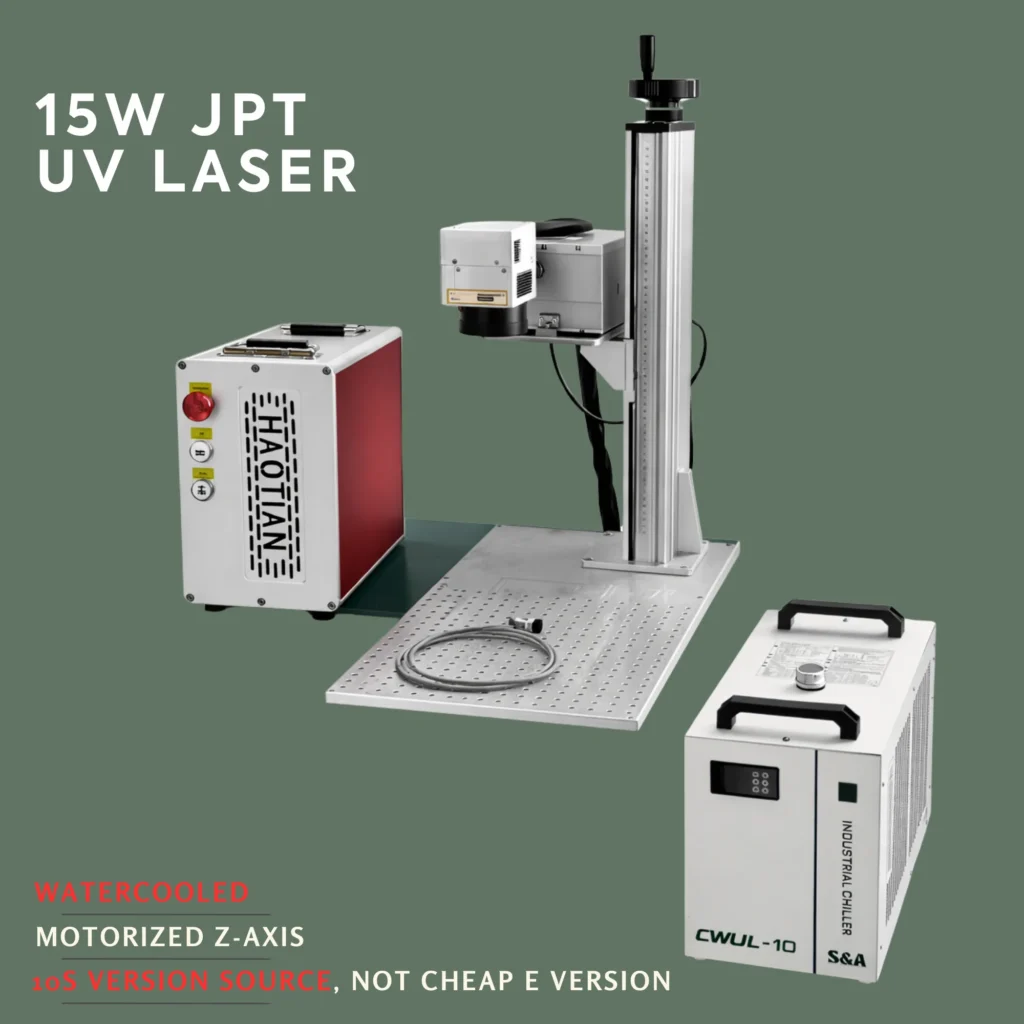
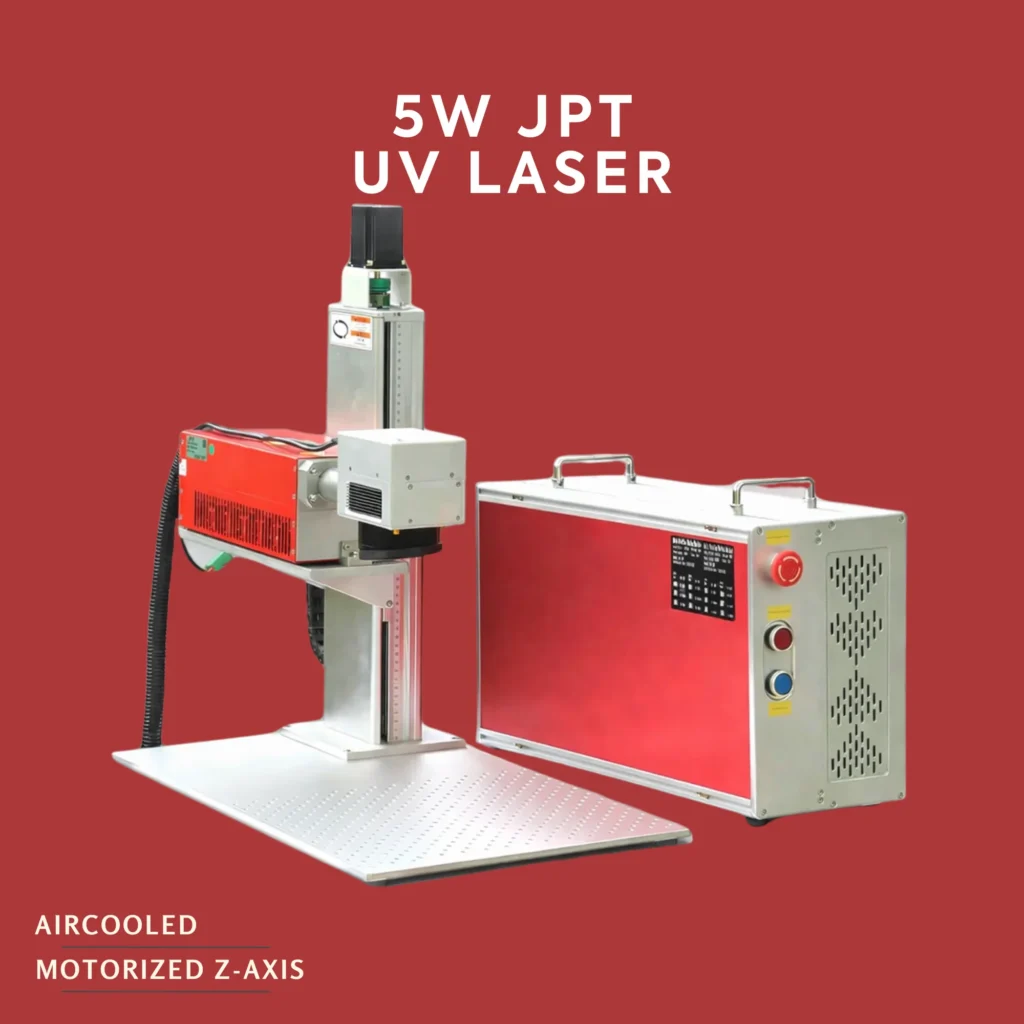
| 5W UV S | 10W UV S | 15W UV S | |
|---|---|---|---|
| Average Power | Greater than 5W | Greater than 10W | Greater than 15W |
| Cooling | Air cooled | Water cooled | Water cooled |
| Duty cycle | Light / intermittent | Continuous production | Heavy continuous production |
| Best for | Entry, small format | Professional workhorse | Maximum UV throughput |
| M² beam quality | ≤ 1.2 | ≤ 1.2 | ≤ 1.2 |
| Source grade | JPT S-series | JPT S-series | JPT S-series |
The 10W UV is the volume choice for shops running UV as a daily production tool. The 5W suits lighter workloads where air cooling is sufficient. The 15W is for shops that need maximum throughput on UV work and are processing high volumes of glass, PCBs, or medical parts every shift.
What Ships In The Crate
- JPT Seal-355-10S ultraviolet laser source (S-series, water cooled)
- Industrial water chiller, matched to the laser cooling requirement
- SG7110 galvo scanning head with UV-grade high-reflectance mirrors
- F-theta lens for 110 x 110 mm standard marking field
- Motorized Z-axis adjustment column
- EZCad 2 software pre-configured with UV material profiles
- LightBurn compatibility for users who prefer that workflow
- Rotary attachment (choice of D60, D80, or D100)
- Safety glasses rated for 355nm UV wavelength
- Foot pedal switch for hands-free triggering
- All cables, USB drive with software and manuals, full documentation
- Remote commissioning support via video call from the Saginaw team
Frequently Asked Questions
Why does the 10W UV cost significantly more than a 100W fiber laser?
UV lasers use a fundamentally different and more complex source architecture. The 355nm wavelength is produced by frequency-tripling a 1064nm infrared beam through nonlinear crystals, which requires precision optics, active temperature control, and much tighter manufacturing tolerances than a standard fiber laser. The DPSS crystal itself is expensive, and the sealed integrated architecture adds further cost. You are paying for capability the fiber laser physically cannot provide, not for more of the same.
Do I need special ventilation for UV marking?
For most applications, standard shop ventilation is sufficient because UV marking releases very little fume compared to CO2 cutting or fiber engraving on some plastics. When marking certain plastics (ABS, PVC-free thermoplastics, coated materials), basic fume extraction to the outside or through a HEPA plus activated carbon filter is recommended. We can include a fume extractor with the order if requested.
How long does a UV laser source typically last?
A JPT S-series UV source in normal production use lasts 20,000 to 30,000 working hours before output drops below rated power. That is roughly 10 years of daily single-shift operation. Water cooling and the sealed architecture are both designed to extend this lifetime, which is why we do not recommend the E economy grade for shops planning to run the laser hard.
Can I use LightBurn instead of EZCad 2?
Yes. The machine ships pre-configured for EZCad 2 because that is the native software for the SG7110 galvo controller, but the laser is LightBurn compatible through the standard galvo controller interface. Most UV users stick with EZCad 2 for production work because the UV material library is more developed there, but LightBurn is a valid alternative if your shop is standardized on it.
What kind of electricity does it need?
The machine runs on standard single-phase power (110V or 220V depending on region) and draws less than 250W average during normal operation. The industrial chiller adds its own power draw which we document in the setup guide. A standard workshop outlet is sufficient for the laser head, and the chiller may need its own circuit depending on your panel layout.
Can I upgrade the marking field later?
Yes. The standard 110 x 110 mm F-theta lens can be swapped for larger field lenses (150 x 150 mm, 175 x 175 mm, 200 x 200 mm, up to 300 x 300 mm) at the cost of some edge resolution. Let us know the field size you need and we will ship the right lens, or you can order additional lenses later and swap them in minutes.
How do I test the UV laser before committing to an order?
We run sample tests in the Saginaw showroom for customers who want to see results on their actual materials before purchase. Mail us a sample at 6191 Sherman Rd, Saginaw, MI 48604 with a note describing the mark you need, and the US director will run the test and return the sample with photos and settings. There is no charge for this service on serious inquiries.
Warranty And Delivery
18-Month Full Warranty
Every Haotian UV laser ships with 18 months of full warranty coverage on the laser source, galvo, power supply, control board, and chiller. If any non-source component fails within the warranty window, we ship a replacement free of charge and the broken part stays with you. No return required for most parts. Source defects require return shipment for JPT manufacturer warranty service, and Haotian covers shipping both ways.
After the warranty expires, lifetime email support continues at info@haotianlasers.com. The support team includes engineers who built the machines, not a general helpdesk.
Free DDP Shipping
Delivered Duty Paid to the United States, Canada, and European Union. All import duties, customs clearance, and taxes are included in the price. Transit time is approximately 30 days from order confirmation, which includes production lead time because every machine is built to order. Faster CIF shipping is available worldwide at approximately 12 days, with the customer handling local duties.
Tracking information is provided once the machine leaves the factory. The US director in Saginaw coordinates final-mile delivery and can arrange a specific delivery window if your receiving location requires one.
Ready To Add UV Capability To Your Shop?
Email the Haotian team with your application, material, and volume. We respond within one business day with a configuration, pricing, and sample test offer.
Email info@haotianlasers.comHaotian Laser, 6191 Sherman Rd, Saginaw, MI 48604