


⚡ 60W MOPA
🔬 JPT M7 E2 Source
🛡️ 2-Year Warranty
💰 Smart Value at $4,100
🚚
Free DDP Shipping
US, Canada, EU
🎯
Full MOPA Control
2 to 500 ns pulse width
🛡️
2-Year Warranty
Source + full machine
🎁
$500+ Free Gifts
Rotary + extra lens
❄️
Air Cooled
No chiller needed
60W JPT M7 E2 Fiber Laser: Full 2.0 mJ MOPA Power at the Best Price in the Lineup
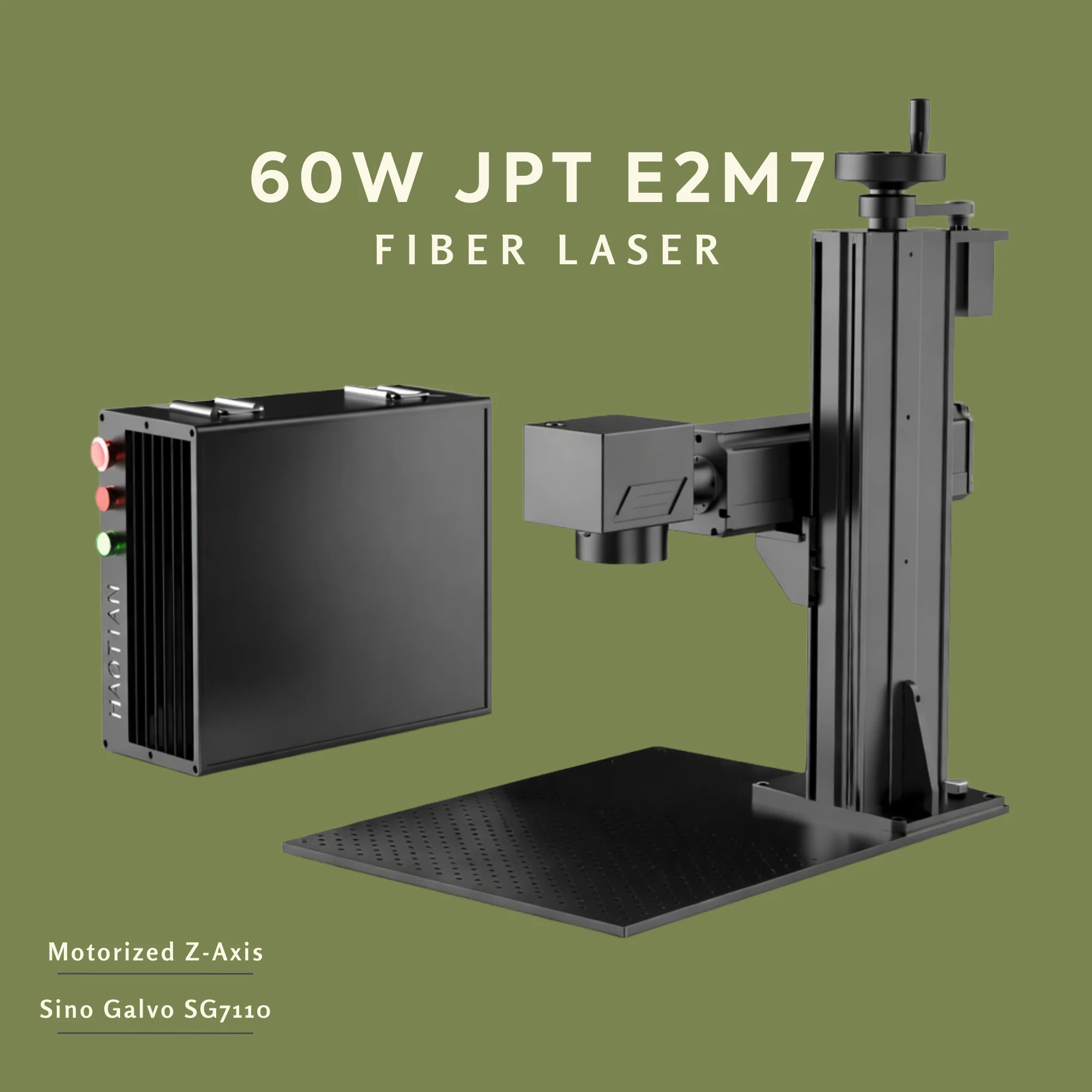
The 60W E2 is the smartest way into JPT M7 MOPA marking: color marking on stainless steel and titanium, deep metal engraving and fine detail work at the lowest price in our 60W range. Inside is the newest JPT YDFLP-E2-60-M7-M-R source with 2.0 mJ pulse energy, 2 to 500 ns pulse width and up to 4 MHz, packed into a compact air cooled module of just 4.1 kg. You get more pulse energy than the $4,400 EM7 and the same 2.0 mJ as the $6,400 M7 M-version, for $4,100.
Core Capabilities
Five Reasons This Machine Earns Its Spot in Your Shop
1
Full Color Marking on Stainless and Titanium
Adjustable pulse width from 2 to 500 nanoseconds gives you the same oxide-layer control as every other M7 machine in the Haotian range. Dial in blues, golds, reds, greens, and purples on 304 and 316 stainless steel or titanium. This is not a stripped-down source. The E2 has 17 preset pulse width modes, each tuned by JPT for clean, repeatable color output.
2
2.0 mJ Pulse Energy for Real Deep Engraving
The E2 delivers 2.0 mJ of maximum pulse energy, the same as the 60W M7 M-version and more than the 1.5 mJ of the 60W EM7. Pulse energy decides how much metal you remove on every pass. For serial number plates, knife handles, firearm parts or jewelry, 2.0 mJ at 60W means real depth without waiting, and shorter cycle times on every deep engraving job.
3
Air Cooled, Compact and Plug and Mark
No water chiller, no plumbing, no distilled water. Like every JPT M7 source, the E2 is air cooled, with a fan that follows the room temperature. It runs on 24V DC with a maximum consumption below 330W, and the source module is only 205 × 253 × 75 mm and 4.1 kg, about half the weight of other 60W M7 sources. Set it on a bench, connect USB and start marking, with operating costs close to zero.
4
Light Metal Cutting Up to Thin Sheets
The 60W handles cutting on very thin metals: foil-gauge stainless, brass shims, thin copper strips. It is not a CNC sheet metal cutter, and this page will not pretend it is. But for small-format cutting tasks like custom jewelry blanks, thin gaskets, or prototype parts in metals under 0.5 mm, the E2 handles it without needing a second machine.
5
EZCad 2 and LightBurn Ready Out of the Box
Ships with EZCad 2 Original (not Lite) pre-configured for your specific lens and galvo calibration. The markcfg7 calibration file is set at the factory for your exact machine. LightBurn Galvo compatibility is built in if you prefer a cross-platform workflow. Mac users go through LightBurn since EZCad is Windows-only. Both options are ready on day one.
Honest Comparison
60W E2 vs. EM7 vs. M7 M-Version: What Actually Differs
JPT builds three 60W M7 MOPA sources. All three share the MOPA design, 2 to 500 ns pulse width, 1 to 4000 kHz frequency, 1064 nm wavelength and air cooling. The differences are pulse energy, beam quality, size and price, all taken from the official JPT manuals.
This Machine
E2 Version
$4,100
- 60W, 2.0 mJ, 2 to 500 ns
- M² below 1.5
- Compact 4.1 kg source, 24V DC
- Newest JPT E2 generation
- Best value for daily production
E Version
E (EM7)
$4,400
- 60W, 1.5 mJ, 2 to 500 ns
- M² below 1.5
- 8.2 kg source, 24V DC
- Proven JPT E series
- Our long running best seller
Full M-Version
M7 M-Version
$6,400
- 60W, 2.0 mJ, 2 to 500 ns
- M² below 1.4, near single mode
- 8.5 kg source, 48V DC
- JPT top tier M7 version
- Built for long production shifts
The honest take: for most shops the E2 is the best value 60W MOPA we sell. It matches the M-version on pulse energy and beats the EM7, at the lowest price. Choose the M-version when you run long production shifts and want the near single mode M² below 1.4.
Specifications
Technical Specifications
| Parameter | Value |
|---|---|
| Laser source | JPT YDFLP-E2-60-M7-M-R (M7 E2 series, MOPA) |
| Average output power | More than 60W |
| Maximum pulse energy | 2.0 mJ |
| Pulse width | 2 to 500 ns, 17 waveforms: CW, 2, 4, 6, 9, 13, 20, 30, 45, 60, 80, 100, 150, 200, 250, 350 and 500 ns |
| Pulse repetition rate | 1 to 4000 kHz, set independently from pulse width |
| Beam quality (M²) | Less than 1.5 |
| Central wavelength | 1064 nm |
| Emission bandwidth at 3 dB | Less than 15 nm |
| Output power instability | Less than 5% |
| Output beam diameter | 7.0 ± 0.5 mm |
| Power tuning range | 0 to 100% |
| Polarization | Random |
| Anti reflection protection | Yes |
| Delivery cable length | 3 m |
| Cooling | Air cooled, fan speed follows ambient temperature, no chiller |
| Source supply | 24V DC, current more than 13 A |
| Source power consumption | Less than 330W maximum |
| Operating temperature | 0 to 40 °C (10 to 30 °C recommended) |
| Storage temperature | -10 to 60 °C |
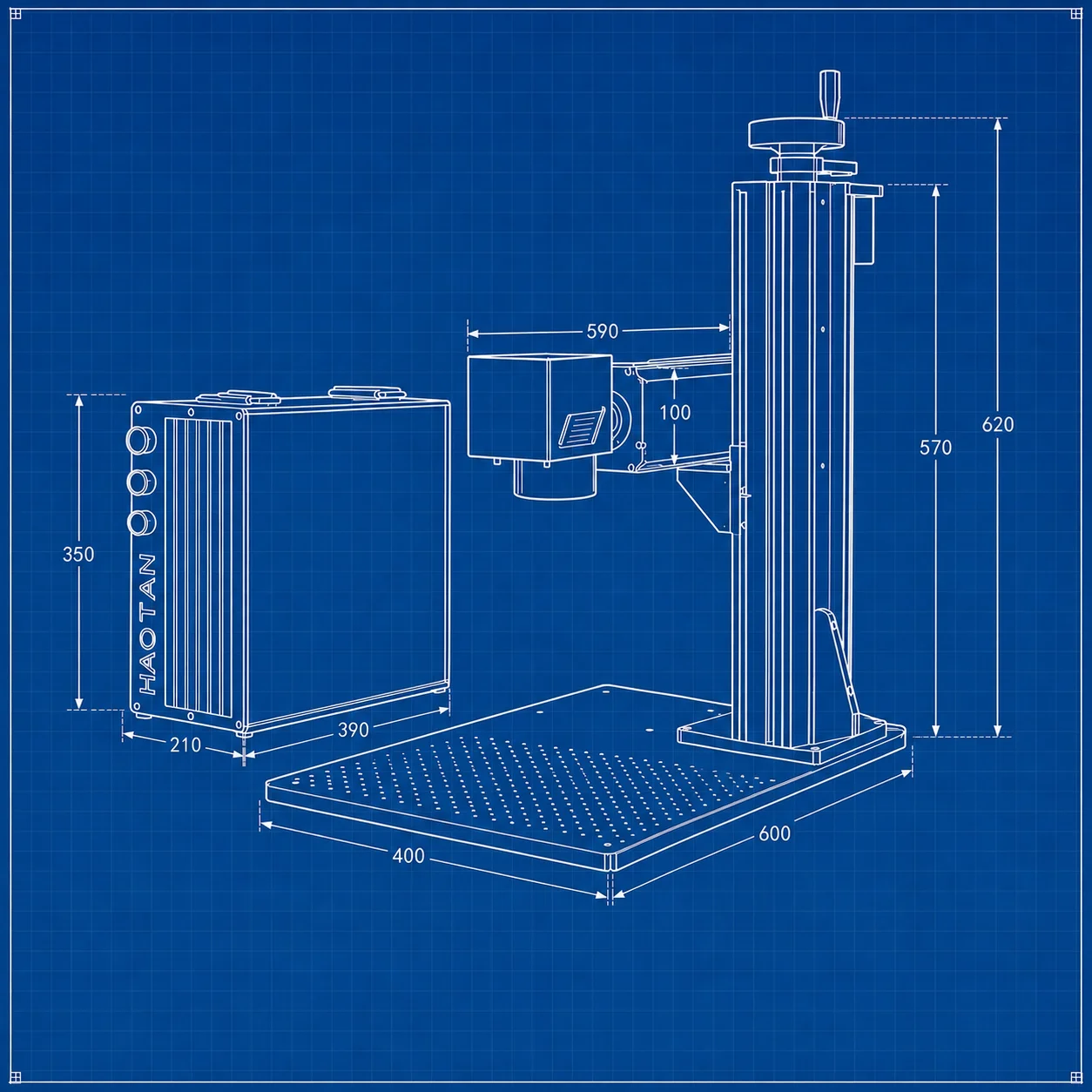
| Source module size | 205 × 253.3 × 75 mm |
| Source weight | 4.1 kg net |
| Laser source lifetime | Built for up to 100,000 working hours |
| Galvo scan head | Sino-Galvo SG7110 (standard) with dual red dot alignment |
| F-theta lenses | Two included, choose from 70×70, 110×110, 150×150, 175×175, 210×210 or 300×300 mm |
| Z-axis | Motorized height adjustment |
| Software | EZCad 2 Original, LightBurn compatible |
| SKU | HT-60-E2M7 |
All laser values above come from the official JPT YDFLP-E2-60-M7-M-R user manual. Download it with the button next to the SKU, or open the JPT 60W E2 datasheet (PDF).
Pulse Settings
Pulse Width and Full Power Frequency
A MOPA source reaches its full 60W only above a certain frequency for each pulse width, called the cut off frequency. Above it you get full average power. Below it the source keeps its peak power and the average power drops. Use these values from the JPT E2 manual when you build your EZCad parameter library.
| Pulse width | Full power from | Maximum frequency |
|---|---|---|
| 2 ns | 1950 kHz | 4000 kHz |
| 4 ns | 1350 kHz | 4000 kHz |
| 6 ns | 975 kHz | 4000 kHz |
| 9 ns | 600 kHz | 4000 kHz |
| 13 ns | 412 kHz | 3000 kHz |
| 20 ns | 252 kHz | 3000 kHz |
| 30 ns | 187 kHz | 3000 kHz |
| 45 ns | 150 kHz | 2000 kHz |
| 60 ns | 135 kHz | 2000 kHz |
| 80 ns | 112 kHz | 2000 kHz |
| 100 ns | 105 kHz | 1000 kHz |
| 150 ns | 57 kHz | 1000 kHz |
| 200 ns | 48 kHz | 1000 kHz |
| 250 ns | 46 kHz | 900 kHz |
| 350 ns | 40 kHz | 600 kHz |
| 500 ns | 30 kHz | 500 kHz |
Common Questions
Concerns You Probably Have (Answered Directly)
Is the E2 a "budget" laser that cuts corners?
No. The E2 is a full JPT M7 MOPA source with the same 2 to 500 ns pulse width, 1 to 4000 kHz frequency and M² below 1.5 as the EM7, and it delivers more pulse energy: 2.0 mJ against 1.5 mJ. The lower price comes from JPT's newer compact E2 design, not from cut specifications. Every value is listed in the official JPT manual you can download on this page.
Will the color marking quality be the same as more expensive MOPAs?
Yes. Color marking on stainless steel and titanium depends on pulse width and frequency control. The E2 has the same 17 waveforms and the same 2 to 500 ns range as every 60W M7 source, so the oxide colors you create are the same as on an EM7 or M-version machine.
Can this machine handle production volume?
For small to mid-sized production, absolutely. The 60W E2 is air cooled with almost no maintenance, and at under 330W source consumption it runs all day on a normal outlet. For long full power industrial shifts where the near single mode beam matters, consider the 60W M7 M-version at $6,400.
How deep can it engrave?
The depth and speed depend on the material, the area being engraved, and your power and speed settings. At 60W with 2.0 mJ pulse energy, the E2 handles deep engraving jobs that would take significantly longer on a 30W machine. For jobs requiring deep engraving as a primary daily workflow, the 100W M7 at $6,900 is the better tool. The 60W handles deep work comfortably but the 100W does it faster on every single job.
Does it come with a warranty?
Full 2-year warranty covering the JPT source and the complete machine. If any part has a quality issue, Haotian Laser ships the replacement at no cost, and the broken part stays with you. Source defects go through JPT's manufacturer warranty, with Haotian Laser covering shipping both ways. After the warranty, lifetime email support at info@haotianlasers.com.
What if I need more power later?
The E2 is a complete standalone machine, not a platform you upgrade by swapping sources. If your volume grows and you need faster deep engraving or thicker metal cutting, the upgrade path is the 100W M7 ($6,900) or the 120W M7 ($7,900). Many Haotian buyers start with a 60W, grow their business, and add a higher-power machine as a second unit rather than replacing the first.
⚠️ What This Machine Cannot Do
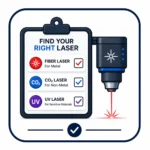
- Not for tumblers or coated drinkware. Fiber lasers burn powder coatings rather than removing them cleanly. Use a CO2 galvo laser for tumblers.
- Not a sheet metal cutter. The 60W can cut very thin metals (foil gauge, under 0.5 mm) but it is not a replacement for a CNC fiber laser cutter. For sheet cutting, look at the CNC fiber laser range (1500W to 6000W).
- Cannot mark wood, leather, paper, or acrylic. The 1064 nm fiber wavelength does not interact with these organic materials. Use a CO2 laser instead.
- Cannot drill or process glass. Glass drilling requires the JPT M8 series with G3 PRO 2.5D galvo and EZCad3 software. For glass surface marking, UV lasers produce the best results.
- Not optimized for PCBs or heat-sensitive components. UV lasers provide cold marking that protects sensitive electronics. The fiber wavelength generates heat that can damage components.
📦 Everything Included in the Box
JPT YDFLP-E2-60-M7-M-R MOPA laser source, built for up to 100,000 working hours
Sino-Galvo SG7110 galvo scanning head with dual red dot focus alignment
Motorized Z-axis tower for button-controlled height adjustment
Rotary attachment (your choice of D60, D80, or D100)
2 F-theta lenses (your choice from 70x70 to 300x300 mm)
OD5+ laser safety glasses
EZCad 2 Original software with factory-calibrated markcfg7 file
Foot pedal switch for hands-free operation
All cables, USB drive, and complete documentation
LightBurn Galvo compatibility built in
FAQ
Frequently Asked Questions
What does "E2" mean in the JPT model code YDFLP-E2-60-M7-M-R?
▾
YDFLP stands for Ytterbium Doped Fiber Laser Pulse. E2 marks JPT's newer economy M7 generation, 60 is the average power in watts and M7 is the JPT MOPA series with adjustable pulse width. The M after M7 is the fiber mode code (near single mode) and R means a built in red guide laser. In short: a 60W MOPA source with 2.0 mJ pulses, 2 to 500 ns and a red pointer.
Can the 60W E2 do the same color marking as the EM7 best seller?
▾
Yes. Both sources share the same MOPA architecture, the same 2 to 500 ns pulse width, the same 1 to 4000 kHz frequency and the same 17 waveforms, so color marking on stainless steel and titanium works the same way. The E2 even has more pulse energy, 2.0 mJ against 1.5 mJ on the EM7, which helps on deep engraving.
Is the E2 a newer source than the EM7?
Yes. The E2 is JPT's newer economy M7 design. Compared with the EM7 it has a much smaller and lighter module (205 × 253 × 75 mm and 4.1 kg against 325 × 260 × 75 mm and 8.2 kg) and higher pulse energy (2.0 mJ against 1.5 mJ), with the same pulse width and frequency ranges. Both remain available, and the E2 is the better value.
Will the E2 last as long as the EM7 or M-version?
Every JPT fiber source, including the E2, is built for up to 100,000 working hours. Keep the air vents clear with at least 10 cm of space in front of and behind the source, and run it in a room between 10 and 30 °C for the longest life. For factories running at full power for long shifts every day, the M-version with its near single mode beam gives extra margin.
What materials can the 60W E2 mark?
▾
All metals: stainless steel, aluminum (bare and anodized), titanium, brass, copper, tool steel, hardened steel, gold, silver, platinum. Also works on some engineering plastics (ABS, POM, nylon) with MOPA-optimized short pulse settings. Does not work on wood, leather, paper, acrylic, glass, or coated drinkware. For those materials, CO2 or UV lasers are the right tools.
How does the 60W E2 compare to a 50W LP-series laser?
▾
The biggest difference is MOPA vs. fixed pulse. The LP series has a fixed 200 ns pulse width and cannot produce color marks on stainless steel or titanium. The E2 has fully adjustable pulse width from 2 to 500 ns, giving you color marking, finer control on heat-sensitive materials, and cleaner results on plastics. The E2 also delivers 2.0 mJ pulse energy compared to 1.25 mJ on the 50W LP, meaning faster deep engraving and more material removal per pass.
Can I use this machine on a Mac?
▾
EZCad 2 runs only on Windows (7, 8, 10, and 11). Mac users run LightBurn Galvo edition, which supports macOS natively and connects to the machine the same way. LightBurn is a separate purchase from LightBurn Software but the Haotian 60W E2 is fully compatible with it out of the box.
What is the markcfg7 file and why does it matter?
▾
The markcfg7 file is the lens calibration data programmed at the Haotian factory for your specific machine and lens combination. It tells the controller how to translate your design coordinates into galvo mirror angles. If this file is overwritten or deleted, your marks will be distorted. Always keep a backup copy before updating software. Haotian can re-send the original file if needed, but restoring from your own backup is faster.
Setup Videos
Watch the Setup Before You Buy
Every Haotian JPT M7 fiber laser uses the same frame, galvo and controller layout, so these videos show exactly what you will do on day one with the 60W E2.
Setup guide
Fiber Laser Unboxing and Setup
Step by step unboxing, assembly and first start of a Haotian JPT fiber laser. The 60W E2 is set up exactly the same way.
En français
Unboxing and Setup Guide in French
The same unboxing and setup steps explained in French for French speaking customers.
🛡️ 2-Year Full Warranty
Covers the JPT laser source and the complete machine for 3 full years from delivery. If any part has a quality problem during the warranty period, Haotian Laser ships the replacement part free of charge and the broken part stays with you.
Source defects are handled through JPT's manufacturer warranty. Haotian Laser covers shipping both directions, so the warranty costs you nothing out of pocket.
After the warranty expires, lifetime email support continues at info@haotianlasers.com.
🚚 Free DDP Shipping
United States, Canada, and EU: Free DDP (Delivered Duty Paid) shipping. Zero customs fees. Zero surprise charges. Approximately 30 days from order to delivery, including production lead time.
All other countries: Free CIF shipping worldwide, approximately 12 to 14 days. Customer handles duties at destination.
Every machine is built to order with your selected lens sizes, rotary, and any optional upgrades configured before shipping.
Explore the Lineup
Consider These If Your Needs Are Different
60W EM7 (E Version)
$4,400
Our proven best seller with the JPT EM7 source, 1.5 mJ pulses and the same MOPA color marking.
100W M7 (Best Value Power)
$6,900
For $2,800 more you get significantly faster deep engraving, thin metal cutting up to 1.5 mm, and higher peak power.
30W JPT MOPA
$3,700
Entry-level MOPA with full color marking. Best for hobbyists, jewelers, and Etsy businesses starting out.
Ready to Start?
Questions about the 60W E2, material compatibility, or which configuration fits your shop? Our team responds within 24 hours.
📧 Email info@haotianlasers.com
Reviews
There are no reviews yet.