


30W Raycus Source
Air Cooled
3 Year Warranty
$500+ Free Gifts
Online Self Service
Free DDPUS, Canada, EU
Free CIFWorldwide shipping
Built InEZCad 2 + LightBurn
3 YearSource warranty
50,000+FB community
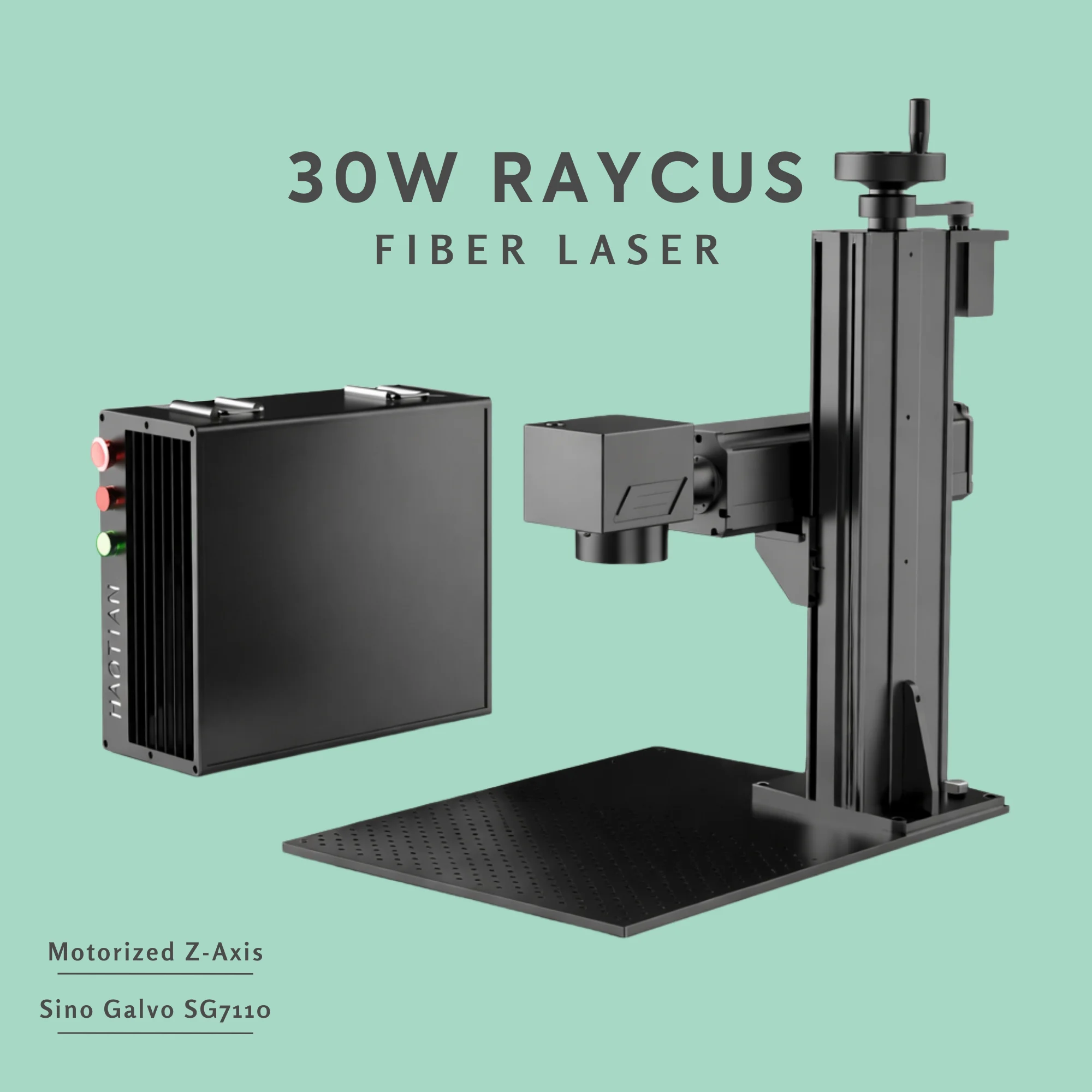
30W Raycus Fiber Laser: Lowest-Cost Entry to Production-Grade Metal Marking
The 30W Raycus is the most affordable fiber laser in the Haotian range. If you need fast, reliable monochrome marking on metals and you do not need color marking on stainless or titanium, this is where the math works in your favor.
Marking speeds reach 5,000 mm/s on standard text and 2D barcodes. Power draw stays low because there is no chiller. The Raycus RFL-P30QS source is the most-shipped Q-switched fiber source in the Chinese laser industry, which means service parts and replacement pricing are the cheapest in the market.
This is not a MOPA laser. Read the limitations section before buying.
Five Reasons Buyers Choose the 30W Raycus
1
The Lowest Total Cost of Ownership in the Lineup
Air cooling means no chiller to buy, no chiller to maintain, no distilled water to manage, and no chiller failure to worry about. Power draw at 30W average is roughly 200W from the wall, so a standard household outlet runs it without any electrical work.
Technical reason: The Raycus RFL-P30QS source is rated at 200W power consumption at 20 degrees C. It uses three rear-mounted cooling fans and operates from 0 to 40 degrees C ambient without a chiller circuit.
2
Production Speed on Common Marking Jobs
Galvo scanning hits 5,000 mm/s on standard fonts, logos, serial numbers, and 2D barcodes. For a small batch shop running tags, asset plates, anodized aluminum, or coated metal parts, the throughput per hour is in the same range as a 50W or 60W marker on simple jobs.
Technical reason: Pulse repetition rate of 40-60 kHz combined with a beam diameter of 6-8 mm and M2 less than 1.6 produces a clean focused spot at the standard 110 x 110 mm working area. The BJJCZ controller drives the galvo head at full rated speed without bottlenecking the source.
3
Cheapest Service Parts in the Industry
Raycus is the highest-volume fiber laser source manufacturer in China. Replacement parts, service technicians, and source modules for Raycus are available at lower prices and faster lead times than any other source brand. If you ever need a part outside warranty, you pay the smallest premium.
Technical reason: Raycus ships more pulsed fiber sources annually than any other Chinese manufacturer. Volume drives down replacement pricing across galvo heads, F-theta lenses, and source modules sourced from third parties for this platform.
4
Plug In and Mark on Day One
EZCad 2 ships pre-configured with starter parameter sets for common materials. LightBurn compatibility is built in for buyers who prefer the LightBurn interface. Output fiber length is 3.0 m, which gives you flexibility in machine layout without the cost of an extended fiber.
Technical reason: The Raycus source uses the standard DB25 industrial control interface that EZCad 2 and LightBurn both recognize natively. The BJJCZ controller is the same controller used across all Haotian fiber lasers, so any tutorials and documentation already in circulation apply directly.
5
Honest Pulse Specifications
Single pulse energy at 0.75 mJ at 40 kHz. Pulse duration 130-160 ns at 40 kHz. Average power 30W. These are real measured numbers from the source manufacturer datasheet, not marketing inflation. You know exactly what you are buying and what it will do.
Technical reason: The Raycus RFL-P30QS is a Q-switched pulsed fiber laser with a fixed pulse profile. Pulse duration is determined by repetition rate and is not user-adjustable. This is the standard Q-switched architecture and it is what allows the unit to be priced at this level.
Technical Specifications
| Laser source | Raycus RFL-P30QS Q-switched pulsed fiber |
|---|---|
| Average output power | 30W (rated, minimum) |
| Wavelength | 1064 nm (1060-1085 nm range) |
| Single pulse energy | 0.75 mJ at 40 kHz |
| Pulse duration | 130-160 ns at 40 kHz |
| Pulse repetition rate | 40-60 kHz |
| Beam quality (M2) | Less than 1.6 |
| Beam diameter | 6 to 8 mm |
| Output power tunability | 10 to 100 percent |
| Polarization | Random |
| Optical isolator | Built in |
| Output fiber cable length | 3.0 m |
| Cooling | Forced air cooled (no chiller) |
| Working voltage | 24 VDC, plus or minus 1V |
| Power consumption | 200W at 20 degrees C |
| Operating temperature | 0 to 40 degrees C |
| Storage temperature | -10 to 60 degrees C |
| Humidity range | 30 to 85 percent |
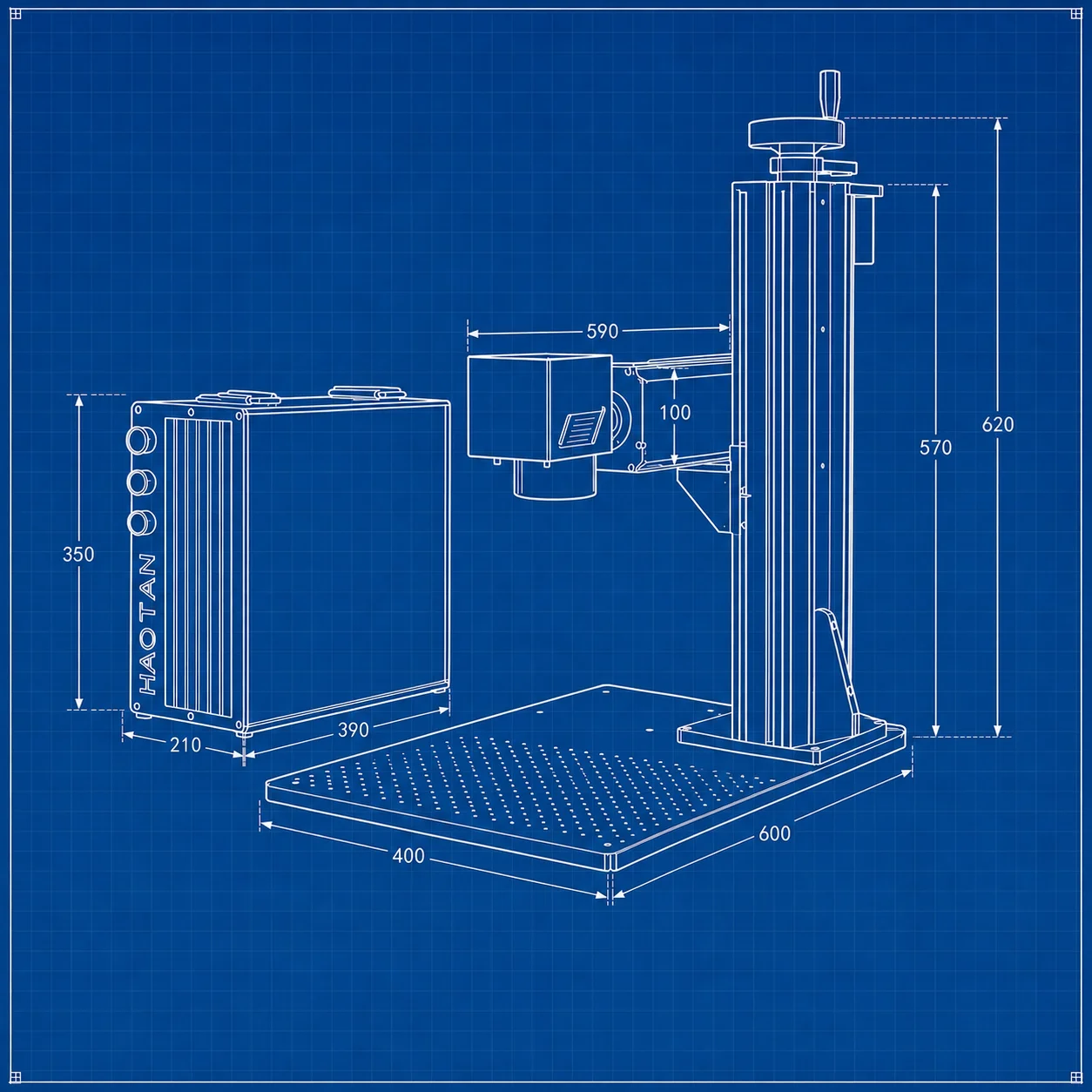
| Working area (standard) | 110 x 110 mm |
| Working area (max optional) | 300 x 300 mm |
| Maximum marking speed | 5,000 mm/s |
| Minimum character size | 0.15 mm |
| Minimum line width | 0.01 mm |
| Controller | BJJCZ |
| Software | EZCad 2 (included), LightBurn (compatible) |
| Operating systems | Windows XP, 7, 8, 10 (32 and 64 bit). Mac via LightBurn. |
| Data transfer | USB 2.0 |
| Graphic format support | PLT, DXF, AI, BMP, JPG, PNG, SVG, and others |
What This Machine Cannot Do
Read this section before buying. Returns are easier to avoid than to process.
- No color marking on stainless or titanium. Color marking requires adjustable pulse width, which is a feature of MOPA fiber lasers (JPT M7, EM7, M8 series). The Raycus RFL-P30QS is a Q-switched source with a fixed pulse profile. If color marking is a current or future requirement, choose the 30W JPT EM7 MOPA instead.
- Pulse duration is not adjustable. Pulse width sits between 130 and 160 ns at 40 kHz, set by the source design. Buyers who need fine control over pulse width for material-specific tuning should look at the JPT MOPA range.
- Not for cutting metal. 30W average power is for marking and shallow engraving. For any meaningful cutting of thin metal, the practical floor is 60W and the productive range starts at 100W.
- Slow at deep engraving. Deep engraving at 30W is technically possible but takes multiple passes. If deep engraving is a regular part of the workflow, the 60W EM7 best seller cuts the time roughly in half and is the better long-term value.
- Cannot process glass. Glass drilling and clean glass marking require different machine architectures (JPT M8 for drilling, UV laser for clean marking). This applies to every M7-class fiber laser, including this one.
- Cannot mark tumblers cleanly. Powder-coated drinkware needs a CO2 galvo machine. Fiber lasers leave burned residue on the coating. This is a wavelength physics limitation, not a power limitation.
- Frequency must stay between 40 and 60 kHz. Operating outside this range damages the source. EZCad 2 and LightBurn both enforce this, but the constraint is real.
Common Buyer Questions Answered
Will it mark my stainless tags clearly?
Yes for monochrome black or contrast marking. No for color marking. If your job requires colored marks, this is the wrong machine. Choose the 30W JPT EM7 MOPA or any other M7-class source instead.
Why is this cheaper than the JPT EM7 30W?
Two reasons. First, Raycus sells in higher volume than JPT, which lowers source pricing. Second, this is a Q-switched source without MOPA capability, so it cannot do color marking. You save on the spec you do not need.
Can I upgrade to color marking later?
Not on this machine. The source is the part that determines color marking capability, and source replacement to a MOPA unit costs roughly the same as buying the MOPA machine new. If color marking is even possibly in your future, buy the MOPA version up front.
How loud is it?
Quieter than a desktop computer. The three rear cooling fans run continuously when the source is powered on. There is no chiller, no compressor, and no pump. A small workshop or even a garage corner is fine.
Does the rotary attachment fit?
Yes. Choose D60, D80, or D100 depending on the diameter of your parts. The rotary controller on this machine is the same as on every Haotian fiber laser, so any tutorial covering rotary setup applies directly.
What about Mac support?
Use LightBurn. EZCad 2 is Windows only, but LightBurn runs on Windows and macOS and supports the BJJCZ controller in this machine. LightBurn licensing is separate from the machine purchase.
How the 30W Raycus Compares to the 30W JPT EM7
| Capability | 30W Raycus (this page) | 30W JPT EM7 MOPA |
|---|---|---|
| Monochrome marking on metals | Yes | Yes |
| Color marking on stainless | No | Yes |
| Adjustable pulse width | No (fixed Q-switched) | Yes (1 to 500 ns) |
| Pulse repetition rate | 40 to 60 kHz | 1 to 4000 kHz |
| Beam quality (M2) | Less than 1.6 | Less than 1.8 |
| Cooling | Air | Air |
| Best fit for | Budget-first monochrome marking | Buyers who need or may need color marking |
What Ships With Every 30W Raycus
- Complete machine with Raycus RFL-P30QS source
- Standard 110 x 110 mm F-theta lens
- One extra lens (your choice from 70x70, 150x150, 175x175, 200x200, 210x210, or 300x300 mm)
- Rotary attachment (your choice of D60, D80, or D100)
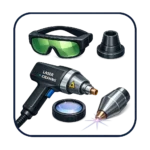
- OD5+ safety glasses
- Foot pedal switch for hands-free operation
- EZCad 2 software with pre-configured material settings
- LightBurn compatibility built in (license separate)
- USB cable, power cable, control cable
- Documentation and quick-start guide
- USB drive with software, drivers, and parameter library
- Three years source warranty plus full machine warranty
Three Year Warranty
Full coverage on the Raycus source and the complete machine for three years from delivery. Non-source parts ship free during the warranty period and the broken part stays with you. Source defects route to the Raycus manufacturer warranty and Haotian covers shipping both directions.
Lifetime email support continues after the warranty period at no charge.
Free Delivery, Built to Order
- Free DDP shipping to US, Canada, EU (approximately 30 days)
- Free CIF shipping worldwide (approximately 12 days, customer handles duties)
- Built to order — production lead time is included in the windows above
- Foot pedal, rotary, extra lens, and safety gear all included at no extra cost
Frequently Asked Questions
Is Raycus a reliable source brand?
Raycus is the largest pulsed fiber laser source manufacturer in China by shipped volume. The RFL-P30QS in this machine is the entry pulsed model and ships in the highest unit count of any source in the Raycus catalog. Reliability for monochrome marking is well established across years of field use. The reason this page is honest about limitations is not because the source is unreliable, but because the Q-switched architecture has hard physical limits that buyers should understand before purchase.
What is the difference between a Q-switched fiber and a MOPA fiber?
Q-switched fiber lasers (like the Raycus RFL-P30QS) generate pulses at a fixed pulse width that is determined by the optical resonator and repetition rate. MOPA fiber lasers (Master Oscillator Power Amplifier, like JPT EM7) use a seed laser plus an amplifier stage, which allows the operator to set pulse width independently of repetition rate. The MOPA architecture is what enables color marking on stainless and titanium because precise pulse width control is required to control the oxide layer thickness that produces color. Q-switched lasers cannot do this.
How long does the Raycus source last in production use?
Pulsed fiber laser sources are typically rated for 100,000 hours of operation, which is more than 11 years of continuous 24/7 use. In a normal small-business workflow running 8 hours per day, 5 days per week, that is roughly 50 years of useful life. The three-year warranty covers manufacturing defects, not life expectancy, because the source typically outlives the rest of the machine.
Can I use this machine outside, in a garage, or in a cold workshop?
The source is rated to operate from 0 to 40 degrees C. Below freezing it will not power on, and above 40 degrees C the cooling fans cannot dissipate heat fast enough. For a typical garage or workshop in climates that drop below freezing in winter, run a small space heater to bring the room above 5 degrees C before powering on. Do not store the machine outdoors.
What materials should I avoid with this laser?
Avoid PVC and any chlorine-containing plastic — these release toxic chlorine gas when laser-vaporized, which damages the optics and harms the operator. Avoid bare reflective metals like polished copper and gold without prior testing — at 30W the reflection risk is lower than at higher powers but still exists. Avoid wood and other organic materials — fiber wavelength does not interact well with them, and you should use a CO2 galvo for those jobs instead.
Does this machine come with the BJJCZ controller pre-configured?
Yes. Every machine ships with the BJJCZ controller flashed with the lens calibration file (markcfg7) for your specific F-theta lens. Keep a backup of this file before any software updates. If the file is overwritten, the machine will mark out of square and the calibration must be restored. Haotian can resend the original file if needed but a local backup is faster.
How do I know if 30W is enough for my parts?
For surface marking on metals (logos, serial numbers, anodized aluminum, painted surfaces, oxide marking on stainless), 30W is enough for any reasonable production volume. For deep engraving (visible cavity in the metal, more than 0.05 mm deep), 30W will work but take multiple passes — the 60W EM7 cuts the time in half. For cutting thin metal (foil, very thin sheet), 30W is impractical; the practical floor is 60W and the production sweet spot is 100W or more. Email us with a sample part description and we will tell you which power level matches your workflow.
Why can I not adjust the pulse width on this machine?
Pulse width on a Q-switched fiber laser is determined by the source's optical resonator design and the repetition rate, not by software. Lowering pulse width below the design range would require a different source architecture (MOPA). The 130-160 ns range at 40 kHz is what the Raycus RFL-P30QS produces by physics. If pulse width control matters for your application, the JPT EM7 MOPA is the right choice and pulse width can be set anywhere from 1 to 500 ns.
Ready to Order or Have Questions?
Email us with your part details and we will confirm whether 30W Raycus is the right fit before you order.
Contact Haotian Laser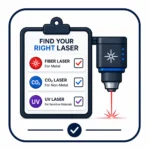
Reviews
There are no reviews yet.