


📈 Step Up From 100W
⚡ 120W M7 M-Version
🔬 JPT Source
🛡️ 3-Year Warranty
🌍
Free DDP Shipping
US, Canada, EU. Duties paid
📐
500mm Z-Tower
Tall workpieces fit easily
🎯
Dual Red Dot Focus
SG7110 Si mirrors
🛡️
3-Year Coverage
Full machine and source
🏗️
Built to Order
Custom configurations
The Smart Step Up
120W JPT M7 MOPA Fiber Laser for Shops Outgrowing 100W
Why Buyers Choose 120W Over 100W
The 120W M7 cuts roughly 15 to 20 percent off your deep engraving cycle times compared to a 100W machine, which adds up to thousands of saved labor minutes per year for any shop running steady production volume. The JPT M-version source uses imported seed and pump diodes, the highest internal grade JPT offers, built for consistent output over thousands of production hours. And because the 120W is fully air cooled like every JPT M7 model, your operating environment, electricity bill, and shop layout stay simple.
This is the machine for shops that have outgrown their 100W and want more headroom without jumping all the way to 200W. It is the right step up when you need to handle larger jobs faster, take on more demanding deep engraving work, or simply give yourself some extra power margin for whatever comes next, but you do not yet need true industrial 200W production capability.
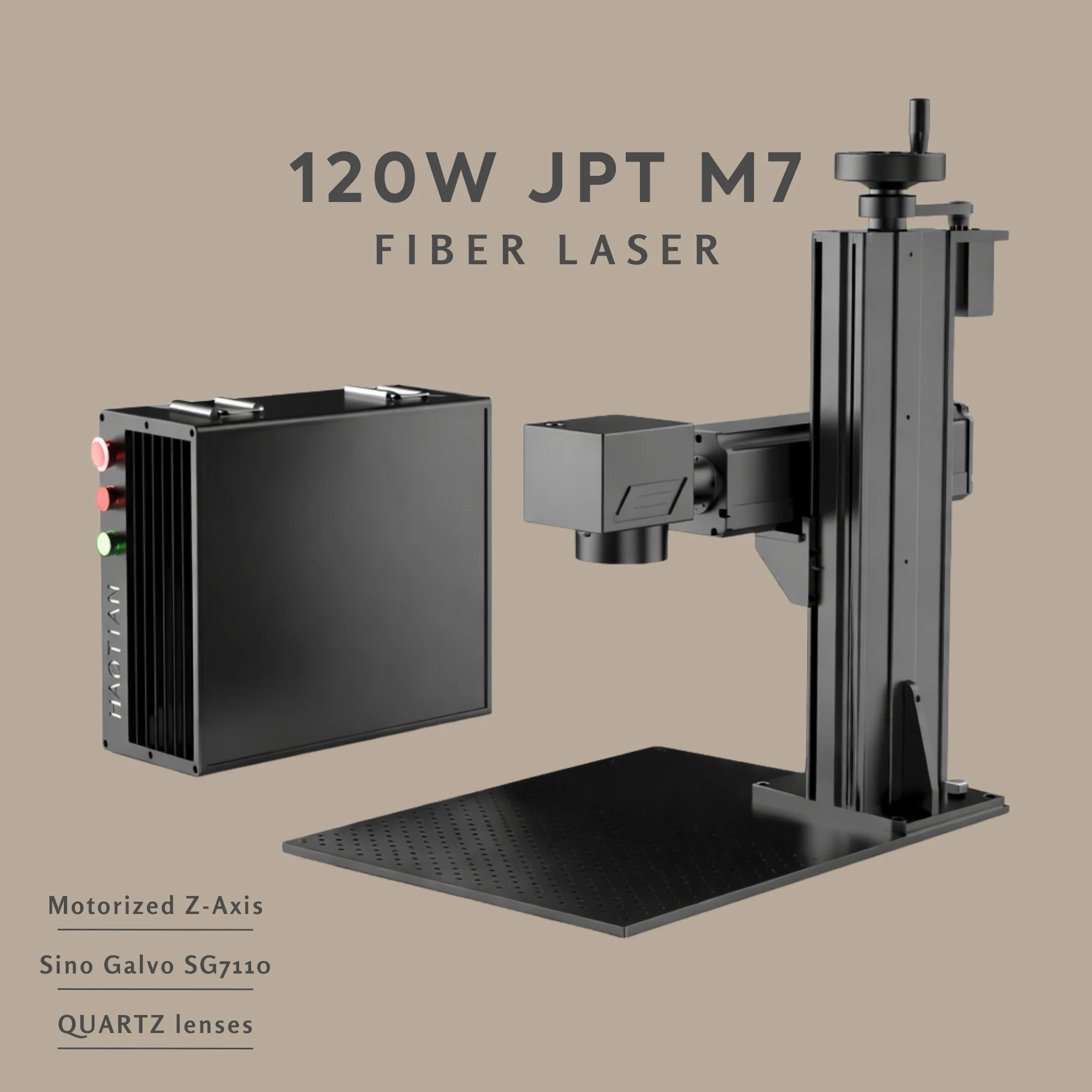
The system is built around the JPT M-version M7 MOPA source (YDFLP-120-M7-M-R) with imported seed and pump diodes, paired with a Sino-Galvo SG7110 scanning head with silicon (Si) mirrors and dual red dot positioning, motorized 500mm Z-axis tower, EZCAD Original software (not the Lite version), and full LightBurn compatibility. Every component is the same grade you would find on the larger 200W M7, just sized to the 120W power level.
Built for Growing Shops
Five Reasons to Choose This 120W
1
20 Percent More Power Than a 100W, At a Fraction of the Cost Difference
Stepping from 100W to 120W gives you a meaningful boost in deep engraving speed and material removal rate without the price jump of going to 200W. A deep mark that takes 6 minutes on a 100W finishes in roughly 5 minutes here, and across hundreds of parts per shift, that compounding time savings shows up directly in your weekly labor costs and your ability to take on more contract work.
2
JPT M-Version Source for Long-Term Beam Stability
The M-version of the JPT M7 series uses imported seed and pump diodes from suppliers in Canada and France, the highest internal grade in the M7 lineup. This is the source production shops specify when they care about beam consistency over thousands of operating hours. Seed source quality directly affects how your laser performs in year three and year four of ownership, not just on day one.
3
SG7110 Galvo with Silicon Mirrors and Dual Red Dot Alignment
The included Sino-Galvo SG7110 scanning head uses silicon (Si) mirrors instead of standard glass mirrors. Si mirrors deliver a higher damage threshold (up to 10 J/cm squared compared to 9.1 for K9 glass), meaning the optics handle high-power continuous operation without surface degradation. The dual red dot system projects two converging laser pointers that overlap at the focal point, eliminating focus guesswork on every job.
4
Motorized 500mm Z-Tower for Any Workpiece
The full 500mm motorized Z-axis tower handles tall workpieces, multi-part fixtures, large rotary attachments, and varied production batches. Button-controlled travel means no manual cranking between job changes, and the motorized positioning gives repeatable focus heights when you switch between different part sizes throughout the day. Practical for shops running diverse work.
5
EZCAD Original Plus LightBurn Compatibility
This machine ships with the full original EZCAD controller and software, not the limited Lite version sold with budget machines. You get every production feature: complete MOPA pulse width and frequency control, batch processing, automatic counters, barcode and QR generation, photo grayscale conversion, and job queuing. LightBurn compatibility on Windows, macOS, and Linux is included for users who prefer that workflow. Use either software, or both.
Technical Data
120W JPT M7 Specifications
| Laser source model | JPT YDFLP-120-M7-M-R (M7 series, M-version, MOPA) |
| Average output power | More than 120W |
| Maximum pulse energy | 1.5 mJ |
| Pulse width | 2 to 500 ns, 17 waveforms including CW (2, 4, 6, 9, 13, 20, 30, 45, 60, 80, 100, 150, 200, 250, 350, 500 ns) |
| Pulse repetition rate | 1 to 4000 kHz, set independently from pulse width |
| Beam quality (M²) | Less than 1.4 (near single mode fiber) |
| Central wavelength | 1064 nm |
| Emission bandwidth at 3 dB | Less than 15 nm |
| Output power instability | Less than 5% |
| Output beam diameter | 7.0 ± 0.5 mm |
| Power tuning range | 0 to 100% |
| Polarization | Random |
| Anti reflection protection | Yes |
| Red pilot laser | Built in |
| Delivery cable length | 3 m |
| Cooling | Air cooled, fan speed follows ambient temperature, no chiller |
| Source supply | 48 V DC, current more than 9 A |
| Source power consumption | Less than 450W |
| Operating temperature | 0 to 40 °C (10 to 30 °C recommended) |
| Storage temperature | -10 to 60 °C |
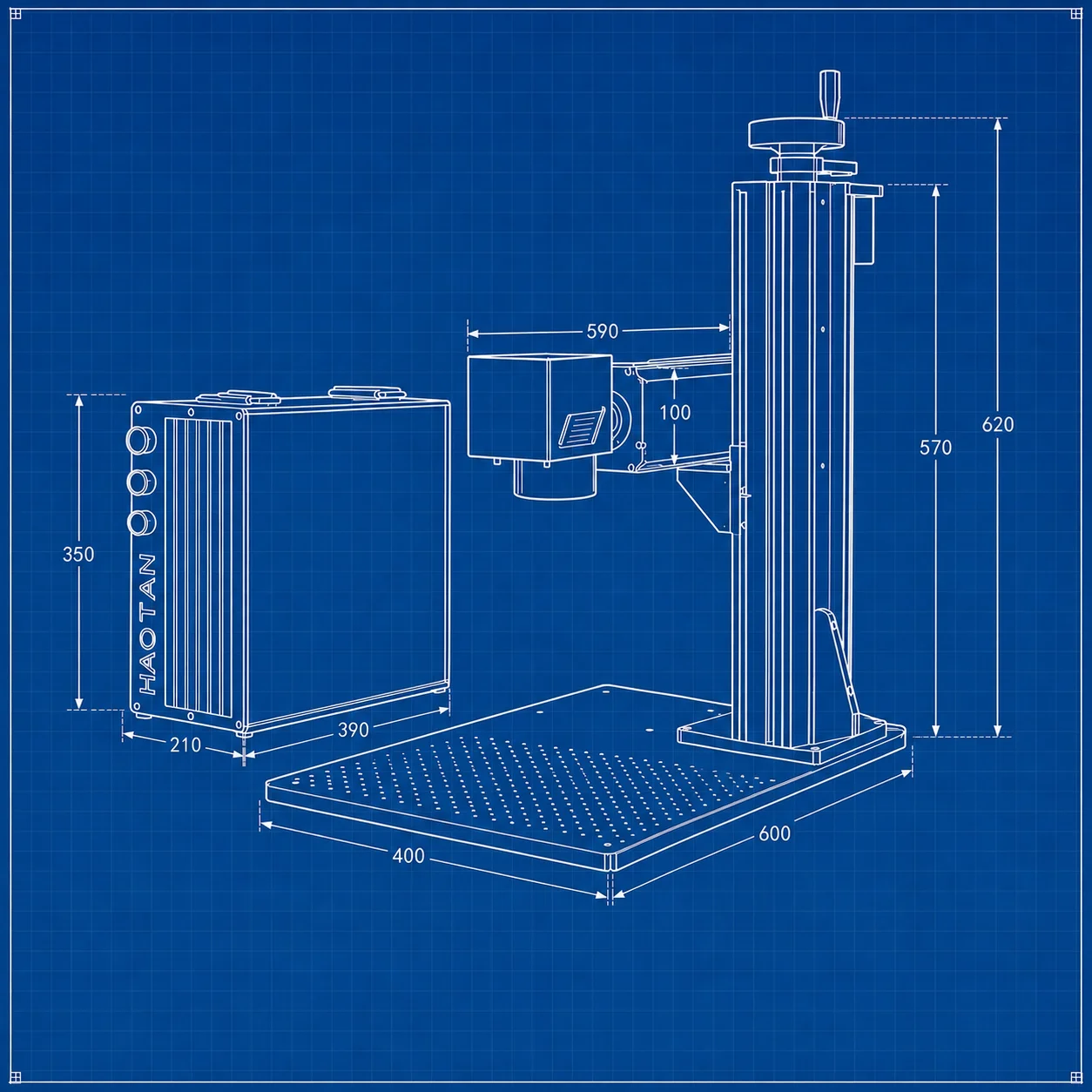
| Source module size | 338 × 280 × 112 mm |
| Source weight | 13.2 kg net, 14.2 kg gross |
| Laser source lifetime | Up to 100,000 working hours |
| Galvo scan head | Sino-Galvo SG7110 with Si mirrors and dual red dot |
| Galvo aperture | 10 mm |
| Maximum marking speed | Up to 5000 mm/s |
| F-theta lenses | Quartz (fused silica), as JPT recommends at this power. Two included, choose from 70x70, 110x110, 150x150, 175x175, 210x210 or 300x300 mm |
| Z axis | Motorized 500 mm tower |
| Controller and software | EZCAD Original (not Lite), EZCAD2 with pre-configured settings |
| Software compatibility | EZCAD Original, LightBurn (Windows, macOS, Linux) |
| Focus positioning | Dual red dot alignment system |
| Foot pedal | Hands-free production switch (included) |
| Machine power input | 110 to 240 V AC, 50 to 60 Hz, single phase |
| Machine body | 100% aluminum, custom colors available |
| Color marking | Full spectrum on stainless steel and titanium |
| Thin metal cutting | Up to 1.5 mm depending on material |
| Safety glasses | OD6 certified |
| Warranty | 3 years on laser source and complete machine |
| Shipping | Free DDP to US, Canada and EU in about 30 days |
Pulse Width and Full Power Frequency
A MOPA source reaches its full 120W only above a certain frequency for each pulse width, called the cut off frequency. Above it you get full average power. Below it the source keeps its peak power and the average power drops. These values come from the JPT M7 manual for the YDFLP-120-M7-M-R. Download the full manual with the button next to the SKU, or open the JPT M7 datasheet (PDF).
| Pulse width | Full power from | Maximum frequency |
|---|---|---|
| 2 ns | 3900 kHz | 4000 kHz |
| 4 ns | 2700 kHz | 4000 kHz |
| 6 ns | 1950 kHz | 4000 kHz |
| 9 ns | 1200 kHz | 4000 kHz |
| 13 ns | 825 kHz | 3000 kHz |
| 20 ns | 500 kHz | 3000 kHz |
| 30 ns | 300 kHz | 3000 kHz |
| 45 ns | 240 kHz | 2000 kHz |
| 60 ns | 216 kHz | 2000 kHz |
| 80 ns | 210 kHz | 2000 kHz |
| 100 ns | 190 kHz | 1000 kHz |
| 150 ns | 115 kHz | 1000 kHz |
| 200 ns | 90 kHz | 1000 kHz |
| 250 ns | 85 kHz | 900 kHz |
| 350 ns | 80 kHz | 600 kHz |
| 500 ns | 80 kHz | 500 kHz |
What Upgrade Buyers Ask
The Practical Concerns Already Handled
If you are stepping up from a smaller fiber laser, you have already learned what matters in real-world operation. Here are the practical questions we hear from buyers making this exact upgrade.
Setup Time From Crate to First Job
Pre-assembled at the factory. If you have ever set up a fiber laser before, this one is faster. Plug in the power, install EZCAD from the included USB drive, and run the dual red dot focus calibration. Most buyers are running their first production job within 90 minutes of opening the crate.
Migrating Settings From an Existing Smaller Machine
Most settings transfer with minor adjustments. If you are coming from a 60W or 100W M7, your existing material parameters work as a starting point. You will need to bump speeds up and reduce pass counts because the 120W removes material faster, but the relationships between pulse width, frequency, and material response stay consistent across the M7 family.
LightBurn Compatibility
Recognized natively by LightBurn galvo mode. The JCZ control board works with LightBurn on Windows, macOS, and Linux. No special drivers, no licensing tricks. EZCAD Original is also included if you prefer it. Use both, switch whenever you want, no conflicts.
Customs and Hidden Import Costs
The price you see is the total cost. Free DDP shipping to the US, Canada, and EU includes all customs duties, import taxes, and brokerage fees. Zero additional cost when the freight company arrives at your door. No surprise invoices weeks later from a customs broker.
Whether to Choose 120W M7 or 120W M8
Glass drilling is the only meaningful difference. If your work is metals, plastics, painted surfaces, or any opaque material, the 120W M7 delivers everything you need at a lower price. If glass drilling or 2.5D mold cavity work is on your roadmap, choose the 120W M8 instead. For most upgrade buyers, the M7 is the right choice.
Service and Parts If Something Fails
3-year warranty with shipping covered. Failed non-source components ship to you free with no return required. Source or galvo defects are repaired or replaced through warranty with all freight covered. Lifetime email support continues forever after the warranty period.
Where 120W Fits
120W M7 vs 100W M7 vs 200W M7
The 120W sits in a deliberate spot between the 100W (the most popular M7 power level) and the 200W (the industrial workhorse). Here is how to decide if 120W is the right step for your shop.
| Consideration | 100W M7 | 120W M7 (This Machine) | 200W M7 |
|---|---|---|---|
| Average Output Power | 100W | 120W | 200W |
| Max Pulse Energy | 1.5 mJ | 1.5 mJ | 1.5 mJ |
| Beam Quality (M²) | Less than 1.4 | Less than 1.4 | Less than 1.6 |
| Internal Component Grade | M-version (imported) | M-version (imported) | M-version (imported) |
| Cycle Time vs 100W | Baseline | Roughly 15 to 20% faster | Roughly 50% faster |
| Galvo Head | SG7110 | SG7110 with Si mirrors | SG2206 dual red dot |
| Si Mirrors Standard | No (K9 glass) | Yes (10 J/cm squared) | Optional |
| Best For | Best value entry to high power | Shops outgrowing 100W | Industrial production volume |
| Cooling | Air cooled | Air cooled | Air cooled |
| Color Marking | Full spectrum | Full spectrum | Full spectrum |
| Thin Metal Cutting | Up to 1.5 mm | Up to 1.5 mm | Up to 2.0 mm |
The 120W earns its place in the lineup for buyers who specifically need more headroom than 100W gives them but do not yet need full 200W industrial capability. If you are upgrading from a 30W or 60W machine because business has grown, the 120W is a meaningful jump that future-proofs your investment without overspending on capacity you might not use for a year or two.
In the Crate
Everything That Ships With Your Machine
No stripped configurations to hit a price point. Every component required for production work is in the box.
JPT M7 120W MOPA laser source, M-version (YDFLP-120-M7-M-R) with imported seed and pump diodes from Canada and France. Built for up to 100,000 working hours.
Sino-Galvo SG7110 high-speed scanning head with Si mirrors and dual red dot focus alignment for precise positioning on every job.
Motorized 500mm Z-axis tower for tall workpieces and varied production setups.
Two quartz F-theta lenses of your choice: 70x70, 110x110, 150x150, 175x175, 210x210 or 300x300 mm.
EZCAD original controller and software (not the Lite version) with full feature access for production work.
EZCAD2 software with pre-configured settings for common materials and operations.
LightBurn compatibility built in for Windows, macOS, and Linux users who prefer that workflow.
Rotary attachment in your choice of one configuration: D60 for rings and small jewelry, or D80/D100 for tumblers and cylindrical objects.
OD6 quality safety glasses rated for the highest protection level on 1064 nm fiber laser radiation.
Foot pedal switch for hands-free production batch operation.
All necessary cables, connectors, USB drive, and documentation required for installation and operation.
Detailed Questions
Frequently Asked Questions
What does YDFLP-120-M7-M-R mean exactly?
This is the official JPT model code for the laser source inside this machine. YDFLP stands for Ytterbium Doped Fiber Laser Pulse. The 120 is the average output power in watts. M7 is the JPT series. The first M is the M-version designation, indicating the highest internal grade with imported seed and pump diodes. The R indicates a built-in red guide laser. Knowing the exact source code matters for warranty claims and parts ordering, so we publish it openly on every product page.
Why do Si mirrors matter on the SG7110 galvo?
Silicon (Si) mirrors have a higher laser damage threshold than standard K9 glass mirrors. K9 handles up to 9.1 J/cm squared, while Si handles up to 10 J/cm squared. This difference matters at higher power levels because high-energy pulses can gradually degrade the mirror coating on lower-grade optics. Si mirrors give you longer galvo lifespan in continuous high-power operation, which is exactly the conditions a 120W production machine encounters during normal use.
How does the dual red dot focus system work?
The galvo head projects two red light beams that are angled to converge at the exact focal point of the laser. As you raise or lower the Z-axis tower, the two red dots move toward or away from each other on the workpiece surface. When both dots overlap into a single point, the laser is precisely focused. This eliminates the need for a focus gauge or trial-and-error focusing, especially when switching between batches of different-height parts during production.
Should I upgrade from my 100W to this 120W?
Yes, if you are running steady production volume and your 100W has become a bottleneck on deep engraving or color marking jobs. The 20 percent power increase translates into roughly 15 to 20 percent faster cycle times across most operations. Both machines use the same M-version source family with 1.5 mJ pulses and M² less than 1.4. If your 100W still handles your volume comfortably and most jobs finish in acceptable time, save your money. The 100W is still an excellent machine.
What is the difference between EZCAD Original and EZCAD Lite?
EZCAD Lite ships with budget fiber lasers and has limited file format support, no advanced job automation, and reduced parameter control. EZCAD Original (included with this machine) is the full software with every feature for production: complete file format support, MOPA pulse width and frequency control, batch processing, automatic counters, barcode and QR generation, photo grayscale conversion, and production-grade job queuing.
Can the 120W M7 do color marking on stainless steel?
Yes, full spectrum. The 120W M7 is a complete MOPA laser with adjustable pulse width from 2 to 500 nanoseconds, the identical range as 60W and 100W M7 machines. Color marking parameters that work on smaller M7 machines also work here. The 120W just produces colors faster and lets you tackle larger color marking jobs in less time. Black annealing on anodized aluminum and titanium color marking are also available.
Can the 120W M7 cut metal sheets?
Yes, up to about 1.5 mm thickness on materials like brass, aluminum, copper, and thin steel. This is a galvo marking laser, not a dedicated CNC cutting machine. For production sheet metal cutting on thicker materials, look at our CNC fiber laser cutters from 1500W to 6000W. The 120W M7 handles marking, deep engraving, and occasional thin cutting in one machine.
Should I buy the 120W M7 or the 120W M8?
Glass drilling is the deciding factor. The 120W M7 handles all metal work, plastics, painted surfaces, and other opaque materials at this power level. The 120W M8 adds the ability to drill and process glass with the G3 PRO 2.5D galvo and EZCad3 software. If glass capability is on your roadmap, choose the M8. If your work is metals only, the M7 saves you money for the same metal performance.
Watch the Setup
See How the 120W M7 Is Set Up
Every Haotian JPT M7 fiber laser from 20W to 200W uses the same frame, galvo and controller layout, so these videos show exactly what you will do on day one with the 120W M7.
Setup guide
Fiber Laser Unboxing and Setup
Step by step unboxing, assembly and first start of a Haotian JPT fiber laser. The 120W M7 is set up exactly the same way, like every M7 model from 20W to 200W.
En français
Unboxing and Setup Guide in French
The same unboxing and setup steps explained in French for French speaking customers.
After You Buy
3-Year Warranty and Lifetime Email Support
The 120W M7 carries Haotian's standard 3-year warranty covering both the JPT M-version laser source and the complete machine including the SG7110 galvo head, motorized Z-tower, and all electronics.
Free replacement parts for 3 years. Non-source components that fail due to manufacturing defects ship to you at no cost. The broken part stays with you. Haotian pays all shipping.
JPT laser source warranty. Defective laser sources must be returned for repair or replacement under JPT warranty. Haotian arranges everything and pays both ways.
Sino-Galvo head coverage. Same return process. Defective scanning heads are repaired or replaced through the warranty channel at no cost to you.
Lifetime email support. Reach our team at info@haotianlasers.com for technical questions, settings advice, troubleshooting, and operation help. For the life of your machine.
50,000+ member Facebook community sharing parameters, project photos, and troubleshooting daily.
Delivery
Free Worldwide Shipping
The 120W M7 is built to order at our factory and shipped with full tracking. Customers in the United States, Canada, and the European Union receive DDP shipping (Delivered Duty Paid) with all customs duties, import taxes, and brokerage fees included in the price. The amount paid at checkout is the total cost. Estimated delivery is approximately 30 days from order. CIF shipping is available worldwide for faster delivery in approximately 12 days.
Other Power Levels
Browse the Full Range
Step Up to Real Production Power
The 120W JPT M7 M-version gives you a meaningful performance boost over a 100W with the same simple workshop footprint. M-version source, Si mirror galvo, EZCAD Original, 3-year warranty, and free DDP shipping with duties paid.
Questions? info@haotianlasers.com · Contact Page
Haotian Laser, 6191 Sherman Rd, Saginaw, MI 48604 · About Us

Reviews
There are no reviews yet.